
This case study begins at 9.A. below. (Click on August, then 9.A. in the Blog Archives at right.) My comments appear in italicized brackets.
February 1994 After eight months and fourteen hearings, Justice Raymond Shawcross, found the mother’s testimony of the father’s abuse credible. He kept a restraining order on Vincent and assigned sole custody and placement of the children with their mother in the marital home. He required Vincent’s visits with the daughter to be supervised.
April 1994 Chief Judge Jeremiah found that Vincent was stalking his wife and failing to pay court-ordered bills for child care or utilites. Mother and children relied on charities for food. The bank was foreclosing on their home. Jeremiah gave the mother permission to move the children to Illinois, where she could work in her brother’s law office and have free housing with her mother. Vincent could visit their son, and the mother must have the daughter evaluated by authorities there.
June 1994 The mother drove back to Rhode Island for a hearing and brought their son to visit his father. Chief Jeremiah expressed frustration with the two attorneys, John Lynch and Nicholas Colangelo, who had failed to agree on drafting the order from the prior hearing. Without a court order, Illinois officials could not provide an evaluation or supervise the family as Jeremiah required. He told the lawyers they were “prohibited from leaving this courthouse” until they had written an order based on the April transcript for Jeremiah to sign.
In the same hearing, Colangelo asked for his client, "Vincent," to have telephone contact with both children in addition to supervised visitation with the daughter in Illinois. Chief Jeremiah responded emphatically:
No, Mr. Colangelo, no visitation and no telephone contact until I get this [evaluation report]. That is an important issue. I need to see the report, and I will continue the matter until I get the report . . . . But there will be no visitation and no telephone conversations until I get the report. (Transcript 6/9/94:9).September 1994 Attorney Colangelo withdrew, and Michael Hagopian entered as Vincent’s lawyer. Chief Judge Jeremiah approved arrangements for Vincent’s supervised visits with his son in Illinois, plus telephone contact with his daughter on Thursdays from 7 to 7:30 p.m.
Vincent prepared a one-page “synopsis” of the transcript of that hearing that misrepresented Jeremiah’s order. (Click on documents to enlarge.)

In his synopsis of Chief Jeremiah's order (above), Vincent wrote:
After consideration, the Court concluded that it would be appropriate for [the mother’s] brother to deliver the child to [the father] for an unsupervised visit with his daughter (p. 6 lines 12-18). [I have italicized key words here and below.]
In fact those lines in the transcript refer specifically to the son alone, for Jeremiah instructed the mother:
… your brother will be there to have the child go with his father.
In his synopsis, Vincent misrepresented another point:
The Court went on to review the report of Childhood Trauma Treatment Program and concluded that there was not a credible story of molestation (p. 7 lines 1-11).
But in fact, Jeremiah’s reference in those lines applied only to the son, not the daughter:
. . . in reviewing the report of the Childhood Trauma Treatment Program, it stated my professional opinion these do not constitute spontaneous disclosures that list the father sexually abused him.
Here are excerpts of the transcript to compare to Vincent's synopsis. His synopsis referred to his former wife's complaints on page 2. In the transcript she is talking about his astonishingly low child support. (Click on documents to enlarge.)


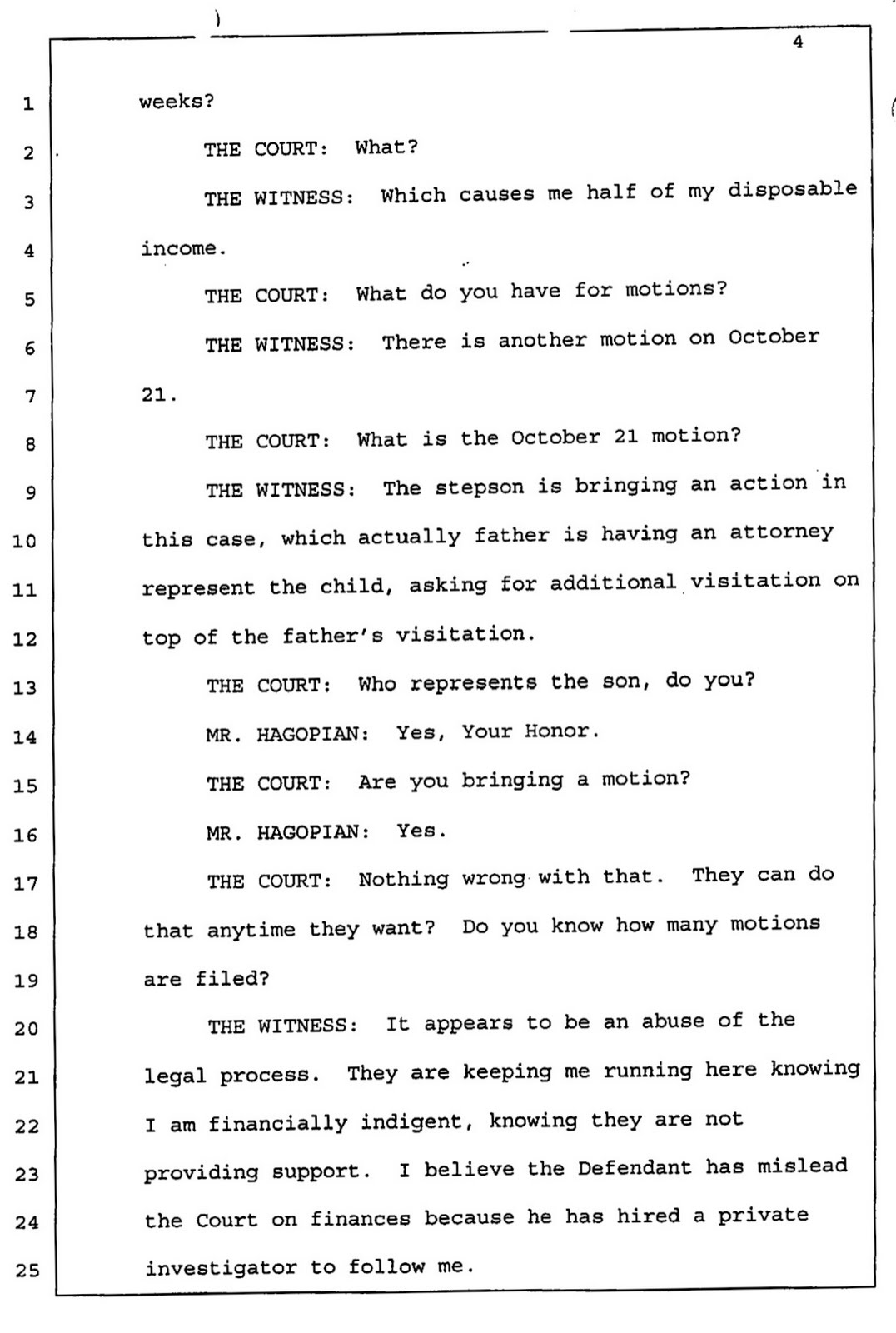
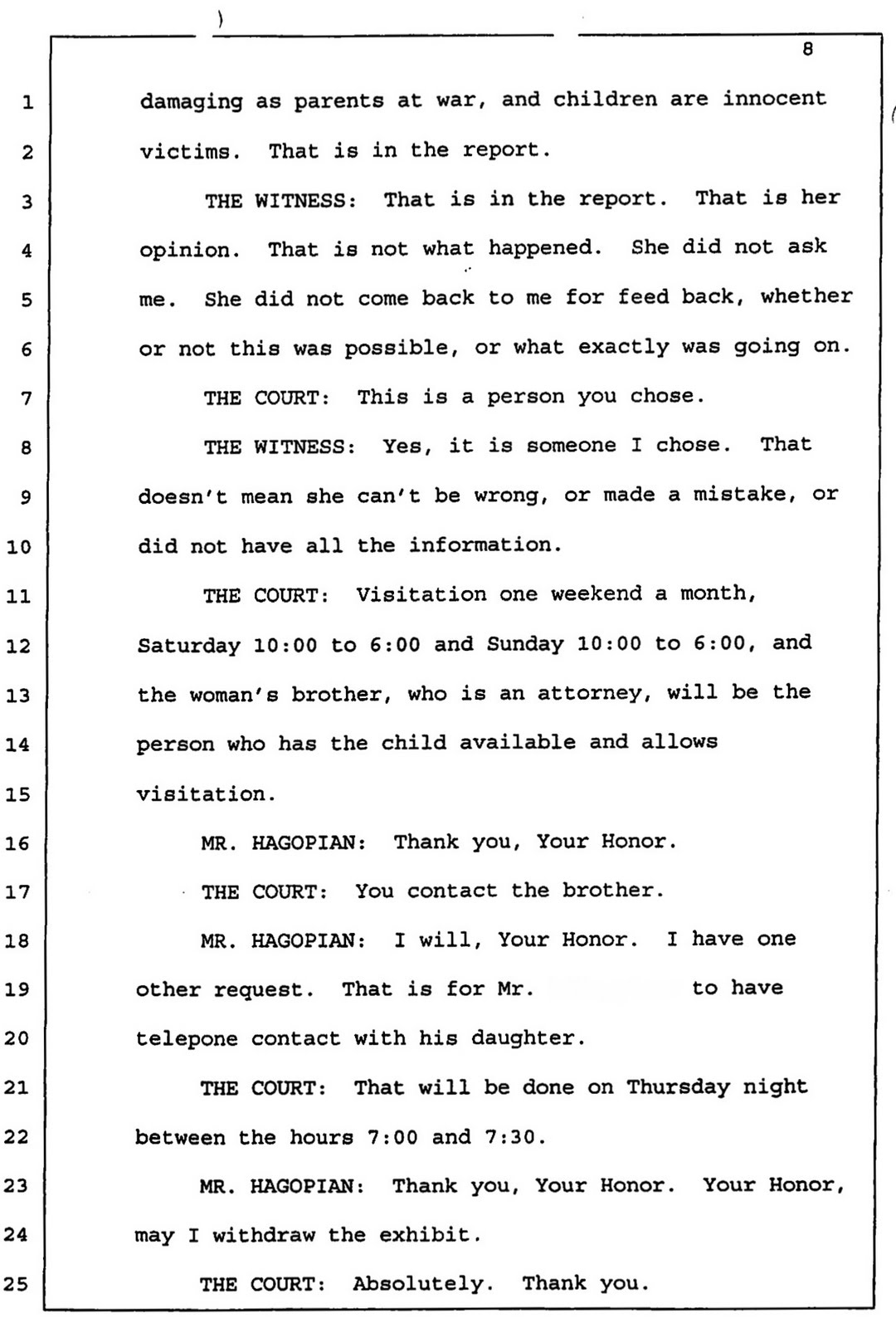
On pages 6 through 8, the transcript refers to supervised visits with his son and phone calls with his daughter. (Vincent's synopsis of the transcript changed this to unsupervised visits with his daughter, with no mention of his son.)


When he drafted the final order, Hagopian did not go as far as Vincent’s synopsis had tried to revise Jeremiah's words. Hagopian drafted the order to give his client unsupervised visits and weekly phone calls with both children, but no overnights. And he got Judge Jeremiah's signature:

But a full decade later, Justice Michael Forte incorrectly described this order as if it had "reinstated unsupervised overnight visits."
After the results (unfounded) of the Illinois evaluation, the Chief Judge reinstated overnight visitation with both children by Order of July 29, 1994. (Forte, Decision, 7/6/2004:2)
[In fact Jeremiah clearly said "no overnights" on July 29. Forte is referring to the written Order of September 26, 1994, pictured above, which followed the Illinois evaluation, but also did not allow overnight visits. Later I will relate how mediator David Tassoni, with Justice Forte punished Vincent's children.
[Lawyers’ paperwork is a frequent cause of delay, expense, inaccuracy, and emotional distress in Family Court due to the failure to follow through on filing essential documents, the misrepresentation of judges’ orders, and the lack of clarity in many orders. Family Court does enormous harm when it uses adversarial litigation in these cases.
[A better option could be for evidence of crimes like domestic violence and sexual abuse to go to the Attorney General, Grand Jury, Superior Court, and jury trials. Helping families resolve ongoing crises would be far better served with a single multidisciplinary team from beginning to end, as described in the prior post. That team could include a writer and clerk responsible for timely filing of coherent and accurate documents. The Court needs to steadfastly remove opportunities for private contractors to profit from inflaming these cases.]
NEXT: 9.E. How "Vincent" got the Chief Judge to apologize.

