Color of Law Custody Cases

Color of Law Custody Cases
Rhode Island and other states often violate civil rights in civil courts when officials threaten to separate children from protective parents who are their lifeline. These cases may include "color of law" abuses that push the boundaries of law. Judges who allow color of law abuse in their courtrooms are guilty of "color of office."

In Family Court, we give judges ultimate power over people’s lives while taking away their curiosity, concern, and even their ability to inquire about what is really happening in these cases. This transfers the power to guardians ad litem and lawyers. These officers of the court can convince a judge--through false allegations that are frequently off the record--to remove children, imprison innocent parents, then bankrupt them through years of frivolous motions, and forbid them to talk about it--all under color of law.

In domestic abuse custody cases, this enables the abusive parent to gain extraordinary power and control over the protective parent and the children.

Here is more information about color of law:


Showing posts with label Judith Lubiner. Show all posts

Saturday, April 7, 2012

10.R. Closing arguments

"Jenny's" letter to "Tracy" from SIG Camp, July 27, 2009.
Wild-eyed warnings launched this case in 2008--a preemptive war that became a 4-year fiasco with little regard for the truth, the cost, or the collateral damage.

Most Family Court judges forbid me to write in “their” courtrooms. In Superior Court I once inquired if I could take notes, and the clerk studied me quizzically: Of course! Why not? She even offered me a pen.

But Family Court is a different culture, with a veiled history of unrecorded conversations and backroom secrets. So I do the best I can to copy the public files, to remember what happens in court and to write it down as soon as possible. (I always welcome corrections, documents and other evidence to comprehend these often astonishing cases.)

On Tuesday, the final day of arguments, Judge Debra DiSegna presides, attentive but visibly weary of the mess others left since that first “emergency” ex parte order of April 23rd, 2008.

All week I’ve been trying to reconstruct Tuesday’s arguments and research the legal citations to be sure I understand their significance. Let’s return to that afternoon at Washington County Courthouse.

The stage is set: a lectern poised between the two attorneys. First up to speak, “Barbara’s” lawyer, Cynthia Gifford, reads her long script at the lectern in a trembling voice for the better part of an hour. As far as I can recall, she does not clearly cite state or federal laws, court rules, findings of fact, evidence, or testimony. She beats a single drum, reminding the judge again, again, and again, that a miserable creature sits at the next table.

Her incendiary words fail to ignite any outbursts from “Tracy.” (Folk wisdom prevails: Whenever you point a finger at somebody else, three of your fingers point back at you.) Gifford accuses Tracy of bullying, scheming, invading privacy, harming a child, and having no remorse.

Gifford advises the Court on something she calls “parental competence,” but she offers no evidence of her qualifications. (The opposing attorney later notes that he has raised five children to adulthood. He has 19 grandchildren. But he chooses to focus his remarks on the law.)

Keven McKenna speaks without using the lectern. He stands beside his client, Tracy, and her ADA assistant. He addresses the judge and occasionally turns to acknowledge half a dozen Gifford fans seated beyond Gifford’s partner, Attorney Cherrie Perkins.

The judge must decide this case based only on the law, McKenna says. He refers to “Jenny’s” birth certificate that names her birth mother, Barbara, and her adoptive mother, Tracy, as natural parents with equal rights. He cites the U.S. Supreme Court ruling in Santosky v. Kramer (No. 80-5889) (455 U.S. 745 753 1982) that the Fourteenth Amendment protects the fundamental liberty interest of natural parents in the care, custody, and management of their child.

He cites King v. King, 114 A.2d 329 333 A.2d 135 (R.I. 1975) that age-change itself constitutes a significant material change of circumstance sufficient to warrant the trial court to reopen prior orders of custody. He reminds the court that four years is forever in the life of Jenny, who has aged from 11 to 15 while this case dragged on. King also holds that the testimony of a 12-year-old child is highly material.

McKenna notes that Parrillo v. Parrillo, 554 A.2d 1043 (R.I. 1989) assures jurisdiction since “the circumstances and conditions that existed when custody was decided have been changed or altered.”

Gallagher v. Dutton, 895 A.2d 124 (R.I. 2006) shows one parent using a restraining order “as a hammer to justify” not letting the other parent share significantly in the child’s life. As a result, the Supreme Court agreed with the trial justice’s decision “to award sole custody and physical placement” to the parent who had been hammered out of the child’s life.

In Pettinato v. Pettinato, 582 A.2d 913-14 (R.I. 1990) the state Supreme Court established a list of factors that must be weighed in an analysis of the best interest of the child when deciding custody:
1. The wishes of the child’s parent or parents regarding the child’s custody.

2. The reasonable preference of the child, if the court deems the child to be of sufficient intelligence, understanding, and experience to express a preference.

3. The interaction and interrelationship of the child with the child’s parent or parents, the child’s siblings, and any other person who may significantly affect the child’s best interest.

4. The child’s adjustment to the child’s home, school, and community.

5. The mental and physical health of all individuals involved.

6. The stability of the child’s home environment.

7. The moral fitness of the child’s parents.

8. The willingness and ability of each parent to facilitate a close and continuous parent-child relationship between the child and the other parent.
Jenny’s stated preference from the beginning was to live with Tracy. McKenna notes that two witnesses, both of them parents, one a psychologist, have testified that they do not consider Tracy a danger to Jenny or to other children.

McKenna avers that Tracy, Barbara and both their homes meet the Pettinato factors--except for the last one:
8. The willingness and ability of each parent to facilitate a close and continuous parent-child relationship between the child and the other parent.
Tracy alone meets that one.

Frankly, I distrust this eighth factor, often called the “Friendly Parent” standard. It sounds good in many cases--except where there has been a history of domestic violence, sexual abuse, or coercive control.

In those cases, the “Friendly Parent” standard has too often opened the door for felonious parents to win sole custody of children they terrorize. When the children refuse to visit them, Family Court routinely punishes these youthful attempts at self-protection. The Court has given countless children to abusive parents, who then cut off all normal communication with the parents who tried to protect them.

While I do not believe Barbara is felonious, she and her lawyers have certainly done everything they could to break Jenny and Tracy’s close relationship.

Three years ago, on June 5, 2009, Dr. Judith Lubiner sent an email to both mothers:
I will be writing a letter to Judge Shawcross letting him know that [Jenny’s] stated preference is to live with [Tracy]. . . . I am hopeful that [Jenny] will feel better knowing that someone has expressed her wishes to the judge.
Lubiner’s exercise in truth-telling apparently provoked some pushback; ten days later she sent another email:
I regret that I impulsively agreed to do something that, upon consideration, believe was outside the boundaries of my role.
A month later, Jenny wrote letters to Lubiner and Barbara from the University of Texas, where Tracy had driven her to attend the Summer Institute for the Gifted (SIG). It was the last summer Barbara would let her attend SIG. The 12-year-old wrote to Tracy:
Dear Mom,
Thank you so much for getting me all the way out to Texas! I know it’s been a hard year for you and you’ve been struggling to pay the bills a lot. I’d like to write this letter . . . to inform you that I am sending the black phone back to [Barbara] because I cannot stand this phone issue any longer . . . .

Another reason why I’m writing you this letter is that I’m afraid [Barbara] and possibly even Judith wont speak the truth about the letters that I sent them and I know I can trust you to speak the truth.

I don’t want to have another year like 7th grade because that was the worst year of my life . . . . There’s so many things I want to do and achieve in life! I want to improve on my violin, do good in repertory, get accepted into Walsh, etc. But I believe that the only person strong enough to help me achieve my goals in life and be my mother too is you.
Judge DiSegna offers no clue to the decision she will render on May 3rd, at 2 p.m. She informs the parties that she will meet 15-year-old “Jenny” in chambers at 3 p.m. to explain her decision directly to the young woman whose future she is now deciding.

Thursday, March 29, 2012

10.Q. Cutting the Gordian knot

Alexander cuts the Gordian Knot, by Jean-Simon Berthélemy (1743–1811) from Wikipedia.org

Let's recap Tuesday at Washington County Family Court:

Everyone is angry. On the witness stand, "Barbara" has nothing nice to say about her former partner, "Tracy," and she's angry that "the blogger" has written about their daughter's positive evaluation at the Gifted Resource Center of New England (10.M. "Zealous advocates," March 14, 2012, below).

Tracy's attorney, Keven McKenna, is angry because Barbara filed an abuse complaint in 2010; Barbara's attorney, Cynthia Gifford, succeeded in getting Judge Raymond Shawcross to sign an extraordinary three-year restraining order to "protect" Barbara and Jenny from Tracy. Barbara still claims to be in fear of imminent physical danger, but admits that Tracy never even came near her.

Judge Debra DiSegna is angry at McKenna's loud, aggressive tone. She stops him and abruptly leaves the bench.

Gifford walks McKenna out and brawls in a voice everyone can hear: "When are you gonna grow up?!"

To which McKenna responds: "When are you gonna grow up?!"

Touché!

Chastened, the attorneys return. Fifteen minutes later, Judge DiSegna is back on the bench with a big book. She calls the attorneys forward to discuss some finer points of law and finishes with a plea: "Do you see any way we can speed this up?"

McKenna says: "Cut the Gordian knot. You have authority to do it."

Aha! A classical reference that means "to cut right to the heart of the matter without wasting time on external details" the way Alexander the Great did with a single stroke of his sword, cutting an intricate knot tied by King Gordius of Phrygia, because an oracle said that whoever undid that knot would become ruler of Asia.

With that clarified, McKenna settles down and asks Barbara what she will do to help reunify their daughter, "Jenny," with her other mother.

Barbara is not keen on this. She says she will encourage Jenny to get counseling, though she has already testified that Jenny resists counseling because she does not trust adults.

When McKenna calls Tracy back to rebut, he asks her the same question in reverse, something like: What will you do to reunify with Jenny, but still maintain her relationship with Barbara?

Tracy promises to make colored calendars that coordinate all three schedules--as she had done for ten years--to help Jenny spend time with each mother.

She lists four steps for reunification:
First, over spring vacation, Tracy wants to take Jenny to see the girl's grandmother, "Gras," who cared for her often, but has been critically ill and anguished over the court case. (In one touching moment, McKenna asks if Barbara knows Gras, Tracy's mother. Tracy responds yes, she was "like a fourth daughter" to her.)

Second, Tracy will pick up Jenny from orchestra on Saturdays and deliver her to school on Mondays and will be free to talk with her teachers, to attend track meets and other events.

Third, Jenny should spend the summer with Tracy to make up for "two and a half years total blackout," but their daughter will be completely free to see Barbara whenever she wants. Jenny will soon drive and be able to travel easily between homes.

Fourth, Jenny should be allowed to audition for the state's performing arts high school and take her own time to explore her interests. She could even repeat tenth grade there, since she is a year ahead for her age. Let her take a break from the pressure and decide how she wants to finish her junior and senior years.

Will you make sacrifices? McKenna asks.

Yes! Tracy says: When I was called up after 9/11, I drove a thousand miles every week to see my daughter. I never missed a visit!

Tracy has a large notebook with 170 exhibits to show that she thought she and Barbara were engaged in a good-faith effort at mediation with the late Dr. Judith Lubiner.

She mentions disturbing items in the court file, including a strangely substituted order without any court stamp. (Perhaps I will return to these later.)

Near the end of the day, Tracy says she felt "deceived." Judge DiSegna stops McKenna mid-question and asks the stenographer: Did you get that? I want the record to show that she felt "deceived."

Suddenly the hearing is over, and final arguments set for April 3rd. Is the Gordian knot getting pulled tighter? Or is it about to be cut?

Friday, March 23, 2012

10.P. "This is not how I do lawyering"


Attorney Christopher Corbett's colleagues consider him mild-mannered. Born under the astrological sign of Libra, he likes to keep things in balance.

His hope to mediate this custody case has evaporated by May 9, 2008, when he finally agrees to represent "Tracy" against "Barbara." Corbett knows that the two women's financial resources are completely out of balance.

With her parents' help, Barbara can wage a costly war at Family Court, while Tracy, who had served in the U.S. Air Force after 9/11, has been hit hard by the recession in 2008. A displaced veteran, she collects unemployment insurance and drives a taxi to make ends meet while training to enter a new field.

On May 21st, Judge Laureen D'Ambra appoints Attorney Kerry Rafanelli guardian ad litem. He requires the litigants to hire his friend, psychologist Judith Lubiner. He talks about them getting psychological evaluations from yet another favored court psychologist, John Parsons. The mounting bills produce gut-wrenching terror.

Corbett knows the severe limits on Tracy's income and works through the summer to draft a three-page settlement on August 21st that preserves joint physical and legal custody "without the interim mediation offered by Mr. Rafanelli," since "we are substantially in agreement."

Rafanelli responds by summoning both mothers to his office "to schedule a joint mediation session" and adds: "At that time I will develop a comprehensive Guardian Order for entry with the Court."

Barbara's attorney, Cynthia Gifford, writes that they want to work with Rafanelli and that her client has decided Jenny will have a "no cell phone policy." The girl can talk on the landline with her other mother only once or twice a day "for a reasonable length of time -- ten or fifteen minutes," which suggests ignorance about pre-teens and about healthy parent-child relationships that encourage adolescents to talk more, not less.

Gifford and her partner, Cherrie Perkins, are fully engaged in this case. Both attend most court hearings--an unusual investment of time and money for two principals of a law firm. Gifford pleads the case; Perkins sits behind her--often accompanied by friends and family (but no longer wearing the spurs I described on January 15th).

As I research the history of the case, I find that sometimes Perkins has come to court alone--appearing solo before Judge D'Ambra on April 24th, 2008, and solo before Judge Raymond Shawcross on September 10th, 2008, after he rotated to Washington County.

Twenty days after Corbett produces the three-page settlement, Perkins ignores his work and takes a single page to court. The transcript and order show she is doing something much the same as she did with Judge D'Ambra at the start of the case (see 10.N. "A color-of-law case," March 19, 2012).
(Click once on documents to enlarge.)

At first, Judge Shawcross and Attorney Perkins talk about Attorney Rafanelli's expanding role since Judge D'Ambra appointed him on May 21st. Now he is trying to mediate between the girl's mothers.

"He is wearing many hats," says Perkins, and Judge Shawcross responds: "As long as he doesn't wear the robe because that's mine."
At the bottom of the next page, the judge asks: "Has all the discovery been completed?"

This is an important question, since the court has statutory requirements, including deadlines, for collecting evidence--the "discovery" phase. Litigants would never waive these unless both sides are confident they have collected all the evidence--clearly not true in this case.

Perkins says something she was never authorized to say: "I don't believe they're going to do any discovery, Your Honor."
"Okay," says the judge. "You waive discovery." Amazingly, he instructs Perkins to write it into the agreement.
If this were truly an agreement that the parties had reached through mediation, it ceases to be that the moment Perkins insertes: "5. The parties waive discovery."
The certification page raises other questions. I would not quibble if Attorney Perkins signed her partner's name and then scrawled her own initials beneath the certification. But if she mails the document to the opposing attorney on September 10th--the same day she appears before Judge Shawcross and modifies the supposed agreement between the parties--she clearly violates the Court's rule to notify the other side in a timely fashion before submitting orders for a judge to sign.

I'm just guessing here--based on Gifford and Perkins' signatures on their 2011 letter to the Judicial Nominating Commission:

When I go back to the original "Consent Order" of May 21, 2008, I wonder if Attorney Corbett has ever seen the document that Judge D'Ambra signed:

Tracy recalls how the escalating conflict astonishes Corbett until he explodes in Rafanelli's office: Is this what you're trying to do--cut [Tracy] completely out of [Jenny's] life, because that's what it feels like!

Finally Corbett tells Tracy: "This is not how I do lawyering." She calls the Volunteer Lawyers' Program at the Bar Association. Corbett withdraws, and Attorney Susan Pires enters her appearance on October 22, 2008.

Tracking Tracy's resourcefulness over these four years--her ability to find principled lawyers and therapists when the Court seems to be playing games without rules or umpires--resembles the way in which she had encouraged Jenny to pursue countless extraordinary opportunities in their first twelve years together.

The history of this case also shows how much Jenny lost by being forbidden to freely communicate with this mother during her teenage years.

Artwork from a book "Tracy" and "Jenny" worked on together.

Monday, March 19, 2012

10.N. A color-of-law case

There appears to be no record of some critical proceedings in this case -- such as the first day, April 23rd, 2008, when Judge Laureen D'Ambra switched "Jenny" from joint custody with both mothers to sole custody with Barbara. (The change was drastic, but that date never appears on the docket sheet.)

Jenny's two mothers, "Barbara" and "Tracy," had entirely different plans for the 23rd -- a Wednesday, when Barbara normally finished work early.

Tracy says she had made an appointment a few weeks earlier for both of them and their daughter to meet Attorney Christopher Corbett, who advertised mediation services in Options Magazine to the LGBT community. Tracy was to pick up Jenny from school and meet Barbara at Corbett's office for a free initial interview at 4 p.m. on Wednesday, April 23rd, to consider working with him on their family's issues.

Barbara had another plan: On April 22nd, she met with Attorneys Cynthia Gifford and Cherrie Perkins to work on a "Motion for Ex Parte Relief," a 12-point "Affidavit in Support of Emergency Order," a 24-point "Miscellaneous Complaint for Custody and Other Relief," and a partially completed list of her bank accounts, income and expenses.

On the 23rd, without notifying Tracy, Gifford and Perkins persuaded Judge D'Ambra to sign an emergency ex parte order awarding Barbara sole custody of Jenny. The documents they prepared are in the court file and entered on the docket sheet the following day. Apparently no record was kept of what they told the judge.
(Click once on documents to enlarge.)
That afternoon, as Tracy and Jenny arrived at Corbett's office, Gifford and Perkins were preparing a subpoena summoning Tracy to a hearing one month later on May 21st and informing her that "the Court has already issued Orders pending the hearing as set forth in the attached Ex Parte Order."

A transcript tells what happened the next day, on the 24th, when attorney Perkins appeared alone at a second ex parte hearing and asked Judge D'Ambra to give Barbara complete control over Tracy's contact with their daughter.

Here's how Perkins portrayed Tracy's actions the previous day:
Your Honor, after I was here yesterday, we informed our client [Barbara] of the court order and gave her a certified copy. We did advise her to contact the Defendant [Tracy]. . . and tell her that she'd retained counsel and give our name and tell her that there had been an order entered; and upon hearing that, the Defendant became a little upset and removed the child from school early, and this was not her day to have the child. . . . The Defendant took her to an attorney's office, which would be a violation of the order . . . . My office received a call . . . from attorney Chris Corbett, saying that he was sitting with the Defendant at the time, which would lead me to believe the minor child was there with him . . . . We left a message [for Corbett] this morning saying if you're going to enter your appearance, you should get down to Washington County Court . . . .
Still hoping to mediate, Corbett waited two weeks before entering his appearance as Tracy's lawyer on May 9th. He and Tracy worked that summer on a settlement, which Barbara and her attorneys rejected. The court hearings were all held without Corbett, and Tracy never met Judge D'Ambra.

Gifford and Perkins had composed the April 23rd order, but Judge D'Ambra inserted additional words: "pending a hearing on the motions" on May 21st. That hearing never occurred, though a key order was signed that day.

Shortly after noon on May 16th Gifford and Perkins faxed a "Consent Order" (perhaps to Corbett) purporting to reflect a hearing five days later on May 21st, "without the taking of testimony." Whether or not the scrawl identified as Corbett's signature was authentic, Judge D'Ambra signed the document that appointed attorney Kerry Rafanelli to be guardian ad litem for Jenny.


Though the judge apparently wrote "8/13" for the next hearing, Rafanelli was back in court on June 24th with his boilerplate order drawn up for the judge's signature, granting him all-encompassing authority without clarifying the cost or setting a limit on the tens of thousands of dollars he could charge Jenny's mothers while exerting complete control over their lives as guardian ad litem.
The Court defines this role in the broadest possible terms. The abuse of power by guardians ad litem , the damage they do to children and families, and their enormous bills are some of the most common complaints against Family Court.

Six days after Judge D'Ambra signed that order, Rafanelli wrote to Tracy and Barbara, once again without ever discussing the cost: "At this time I think it is in the best interests of the minor child to be involved in counseling" with psychologist Judith Lubiner.

Those first nine weeks reveal the patterns that played out repeatedly and still continue in this case and other color-of-law custody cases:
1. the use of ex parte emergency motions;
2. failure to notify the other side of court hearings;
3. creating fraudulent narratives, story-lines, and court histories;
4. accusing the other side of violating court orders that were not yet entered;
5. bullying and harassing the other side;
6. creating a professional cabal to financially exploit litigants and their children.
Three years later, Dr. Lubiner sat beside Attorney Rafanelli at a hearing of the Judicial Nominating Commission, forced to listen as Tracy and other parents testified against Rafanelli's bid to become a judge. Commissioners received 69 letters of support for him--17 more than the other eight candidates combined. His pile included a 4-page letter from Lubiner, two pages from Gifford and Perkins and two each from Judge Shawcross and Judge DiSegna. Those enthusiastic accolades may have hurt as much as the attacks did, for Commissioners dropped him on their first ballot.
(The Rhode Island Monthly lionized Attorney Kerry Rafanelli and two other guardians ad litem in their October 2003 issue.)

For more on cabals of court, see the February 22 and March 16, 2012, posts at
http://CustodyScam.blogspot.com
and
http://LittleHostages.blogspot.com/2009/12/why-did-lise-iwon-do-it.html

Friday, February 24, 2012

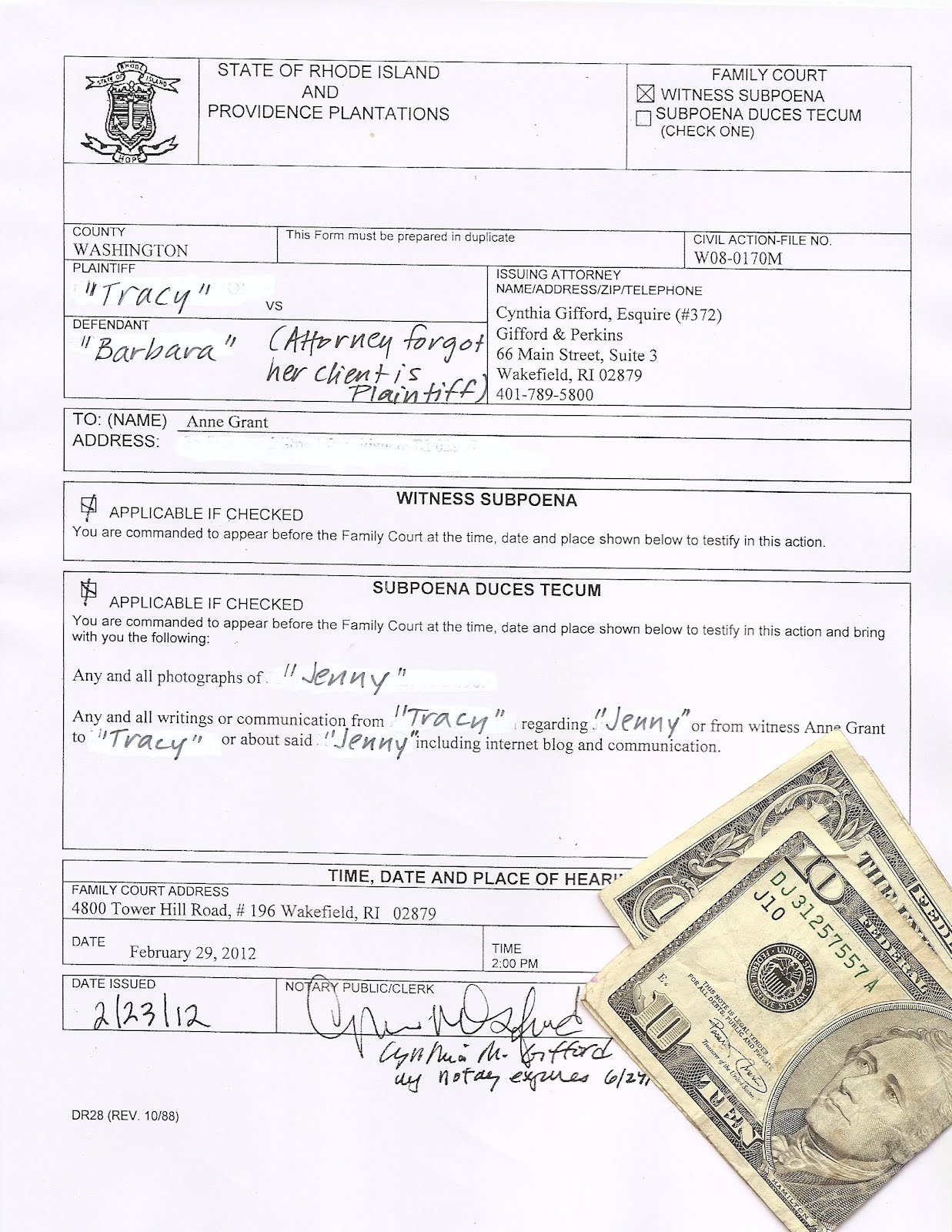
10.H. My $11 ticket to the courtroom

(Click once to enlarge.)


As expected yesterday I finally got my subpoena, accompanied by the usual $11.00 witness fee. (Someone in our Family Court industry--that scarfs up 20.8 million taxpayer dollars in Rhode Island's 2012 budget--has a sweet sense of humor.)

The subpoena forced me to sit outside the room yesterday, so that Gifford and Perkins did not have to read my courtroom observations on this blog today. It gave us both some breathing room, more time for me to research the cabal that has been feeding off this child.

On February 29th, they will devour my documents in a fishing expedition to vilify Tracy, Jenny's lifeline Mom. Gifford will ask me questions, slowly and painstakingly, to stretch out her billable hours.

I want to cut the cost to Barbara's family by providing a few answers here:

Q: What is your name?

A: Anne (with an e) Grant

Q: What do you do?

A: I'm a retired minister and a writer.

Q: Is "Tracy" a friend of yours?

A: She is friendly. But we focus only on the Court. We do not socialize.

Q: When did you meet Tracy?

A: In 2009. Someone referred her to me after reading my book review in the Providence Journal that described narcissism in Family Court hearings. Tracy came to talk with me at the Mathewson Street Church.

Q: What did you talk about?

A: About their family history and what was happening in this case.

Q: Did you offer to help her?

A: I told her how I research cases.

Q: And what did you tell her?

A: First, I'm not a lawyer and I cannot offer any legal advice.

Q: And what else?

A: Second, I accept no money.

Q: Who pays you?

A: No one.

Q: What else did you tell her?

A: Third, I do not represent any litigant, but I try to see what the child's needs and concerns are. If Tracy wants me to do that, she must give me all the documents she can, including photographs, drawings, letters, anything that will help me understand how the Court is handling this case. Then I will access the public file at court.

Q: Anything else?

A: I will attend hearings, but not on either party's side. I will focus on the court process and how it seems to help or hurt the child. If I consider the process harmful or legally abusive, I may challenge it in my writing.

My purpose is to stop Family Court from harming children and families, to make it accountable for its actions, to end abuses by officers of the Court.

Q: What else did you tell her?

A: That I will keep what she tells me in confidence. I will not write about the case unless I believe it is in her child's best interest to expose what is happening. I will use false names. She may not agree with some of my conclusions. I will always welcome corrections from her or anyone else.

Q: Did you ever meet Jenny?

A: Yes. Whenever possible, I want to meet the children I write about.

Q: When?

A: 2009.

Q: Where? At the Temple to Music in Roger Williams Park. At Goddard Park.

A: What did you talk about?

Q: Mostly we played--some games with a ball, something like hacky sack in a sock. Jenny taught me to find crabs at the beach.

A: Did you talk with her about court?

Q: Very briefly. I told her that I research custody cases to find ways that might improve the Court's work with children. I said her ideas are important.

A: Was Tracy part of that conversation?

Q: No. I asked her to watch from a distance, said I needed to hear from Jenny in private.

A: What else did you ask Jenny?

Q: I encouraged her to talk to the court-ordered psychologist, Dr. Judith Lubiner. She said it didn't help. No one listened to her.

At this point Attorney Gifford will ask the judge to strike my answer: Hearsay! and change the subject.

Q: Why did you post old photos of Jenny online?

A: Because it helps readers understand the importance of this relationship.

Q: What about the photo from 2009? People will recognize them.

A: Anyone who recognizes them already knows that horrible rumors have been spread like slander in our community about Tracy. Somebody needs to let people know there is more to this story than what they have been told.

Q: And you think that's your job?

A: I think it's everyone's job. This Court operates with our money and in our name. If we do not speak up, then we share the shame.

Q: What about the other children in the picture? Did their parents give you permission to use that picture?

A: Yes, their mother took the picture. She said Tracy would let me use it, too.

Q: Did you take pictures of Jenny at her concerts?

A: Yes.

Q: And you gave them to Tracy?

A: Yes.

Q: Why?

A: Because it's wrong for you to keep Tracy away from Jenny's concerts, her graduation, her track meets. At her concerts, I've seen how Jenny stands alone and searches the audience. She's looking for Tracy.

Q: When did you take this picture?

A: May 21st, 2011.

Q: Did Jenny know you were taking her picture for Tracy?

A: Yes, I told her, and her whole face lit up. She's a beautiful young woman. She deserves to live at peace with each of her mothers.