Color of Law Custody Cases

Color of Law Custody Cases
Rhode Island and other states often violate civil rights in civil courts when officials threaten to separate children from protective parents who are their lifeline. These cases may include "color of law" abuses that push the boundaries of law. Judges who allow color of law abuse in their courtrooms are guilty of "color of office."

In Family Court, we give judges ultimate power over people’s lives while taking away their curiosity, concern, and even their ability to inquire about what is really happening in these cases. This transfers the power to guardians ad litem and lawyers. These officers of the court can convince a judge--through false allegations that are frequently off the record--to remove children, imprison innocent parents, then bankrupt them through years of frivolous motions, and forbid them to talk about it--all under color of law.

In domestic abuse custody cases, this enables the abusive parent to gain extraordinary power and control over the protective parent and the children.

Here is more information about color of law:


Showing posts with label Raymond Shawcross. Show all posts

Tuesday, May 8, 2012

The Lesbian Mafia


I recoiled when I first heard “Tracy” refer to Attorneys Cynthia Gifford, Cherrie Perkins, and Lise Iwon as the “Lesbian Mafia.” They are no more representative of most gay women than La Cosa Nostra is of most Italians.

But that’s how they make me feel, Tracy said.

When she and “Barbara” moved from gay-friendly Washington, D.C., to Rhode Island’s Washington County in 1991, she said their windows got pelted with eggs. The two women eventually connected with a circle of gay friends, but Tracy said her ASD symptoms often made her the butt of their jokes. Some people got to know and appreciate her quirks, her kindness, her quick mind and facility with numbers.

The lawyers who represented Tracy said that Gifford and Perkins’ intense personal involvement in this case was troubling both in chambers and in the courtroom. Last Thursday, the Gifford and Perkins entourage welcomed Iwon to Washington County Courthouse like a returning don.

Their posse deliberately sat in Tracy’s line of vision. One called out to Perkins: “Sit over here.”

“No,” she said and kept a circle of empty seats around her. “I want to really be able to concentrate on [Tracy.] Send all my good thoughts.”

Her glare put the evil eye on the defendant, who stood ramrod straight like a prisoner in the dock to hear the judge’s sentence. She was expecting the worst.

Iwon sat across the aisle from me writing on her legal pad to show that she as a lawyer -- an “officer of the court” -- was allowed to do what I as a non-lawyer was not.

Judge Debra DiSegna fell in line with them. She did not admonish Gifford or Perkins for the violations of due process that littered the case these four years. Her Decision ran over 60 pages. What she read aloud never acknowledged the errors of two prior judges. How could she? This is not a system that self-regulates, though it professes to.

She quoted from questionable documents, including one that claimed to be an agreement from a meeting Tracy maintains never happened with guardian ad litem Kerry Rafanelli. Judge DiSegna cited a mysterious document from June 29, 2009, when Gifford slid four orders under Judge Raymond Shawcross’s pen without any notice to Tracy or copies to give her in court. One document had not even been stamped by the clerk. DiSegna never mentioned Barbara’s missing green financial forms.

How does mischief like that keep happening without consequences? The judge excoriated Tracy for taking her complaints to Rhode Island’s more law-abiding Superior and Supreme Courts.

Judge DiSegna reconfirmed sole custody and placement to Barbara. Fifteen-year old “Jenny” will stay at her local high school and not be allowed to audition for the state’s preeminent school for performing artists.

Even though Barbara admitted Tracy had never assaulted her, DiSegna kept a 3-year restraining order in force for Tracy to stay away from Barbara and Jenny until December 2013.

She allowed Tracy unsupervised visits with Jenny from noon to 3 pm every other Saturday -- at least until summer, when Barbara usually sends Jenny away to camp.

DiSegna said Tracy and Jenny could have daily 10-minute phone calls, but they must not text each other. Tracy can attend Jenny’s public events as long as she stays away from Barbara. Most of those events are over -- except for a concert on May 12th.

On the day of her Decision, the judge said Tracy and Jenny would have an unsupervised visit in the law library after she privately explained her Decision to the teen.

That was when Judge DiSegna learned that Gifford and Barbara had already flaunted the Court’s instructions. They had not brought the girl to the courthouse for a 3 p.m. meeting as the judge directed. It was 3:30 when Barbara went to get Jenny.

Tracy simply left the courthouse. Later she sent me an email explaining why she did not wait to see if there might be a visit after all. By then there would be scarce time for them to meet, she wrote. More important, the Court’s Decision left Tracy in no condition to visit. It would not be good for her daughter to see her this way.

People without children or without good relationships to their children, who are not on the ASD spectrum and do not suffer post-traumatic stress disorder might not understand this.

Tracy needed to leave, she said. She knew the limits of this sort of sensory overload. She needed time to absorb the Decision. After nearly three years separated from her daughter, there could be no sweet reunion in the courthouse library, no matter what DiSegna imagined.

And what could a teenager like Jenny and a mom like Tracy say in just a 10-minute phone call? Trying to squeeze in everything that matters could tie up their stomachs day and night.

I once thought Judge DiSegna was genuinely interested in Dr. Ronitte Vilker’s insights on autism. So who prompted the judge to taunt Tracy three times in her Decision with the offensive term that the Diagnostic Manual is removing and Vilker herself avoids?

Judge DiSegna had buttressed Gifford’s demands, forcing Dr. Vilker to cancel her patients' appointments and return to court again and again, to hand over federally protected documents in violation of both the Americans with Disabilities Act Amendments and Rhode Island Disciplinary Rules.

Five days have passed since the Decision, and the visitation order has arrived for Tracy to get a 3-hour unsupervised visit with Jenny and attend her performance May 12th, the day before Mother's Day. The document is a jumbled mess in Gifford's handwriting, crossed out, scribbled over, and barely legible. But the judge signed it.

This much is clear: it is a trick. The order gives Tracy's name incorrectly--the old domestic partnership name. She has no I.D. cards with that name. Four years ago she claimed her own name. This sloppy order means nothing compared to the restraining order that could take her to prison. Police will arrest her if she comes near Jenny on May 12th with only her current I.D.

This is the kind of ruse I’ve seen batterers use in this court for decades. It is calculated to trigger all Tracy's symptoms--ASD, PTSD--with no concern whatsoever for her or her daughter. As much as this teenager longs to see her mom, she will probably have to wait until she turns 18.

Raymond L.S. Patriarca, don of the New England mob, held special affection for the smallness of Rhode Island, saying that all he needed here were a few cops and judges to corrupt the entire state.

Family Court has cabals thick as thieves allowed free rein to demand exorbitant fees and to torment their enemies. If Chief Judge Haiganush Bedrosian can clean up here, she will need to end their flagrant abuse of process.


Thursday, March 29, 2012

10.Q. Cutting the Gordian knot

Alexander cuts the Gordian Knot, by Jean-Simon Berthélemy (1743–1811) from Wikipedia.org

Let's recap Tuesday at Washington County Family Court:

Everyone is angry. On the witness stand, "Barbara" has nothing nice to say about her former partner, "Tracy," and she's angry that "the blogger" has written about their daughter's positive evaluation at the Gifted Resource Center of New England (10.M. "Zealous advocates," March 14, 2012, below).

Tracy's attorney, Keven McKenna, is angry because Barbara filed an abuse complaint in 2010; Barbara's attorney, Cynthia Gifford, succeeded in getting Judge Raymond Shawcross to sign an extraordinary three-year restraining order to "protect" Barbara and Jenny from Tracy. Barbara still claims to be in fear of imminent physical danger, but admits that Tracy never even came near her.

Judge Debra DiSegna is angry at McKenna's loud, aggressive tone. She stops him and abruptly leaves the bench.

Gifford walks McKenna out and brawls in a voice everyone can hear: "When are you gonna grow up?!"

To which McKenna responds: "When are you gonna grow up?!"

Touché!

Chastened, the attorneys return. Fifteen minutes later, Judge DiSegna is back on the bench with a big book. She calls the attorneys forward to discuss some finer points of law and finishes with a plea: "Do you see any way we can speed this up?"

McKenna says: "Cut the Gordian knot. You have authority to do it."

Aha! A classical reference that means "to cut right to the heart of the matter without wasting time on external details" the way Alexander the Great did with a single stroke of his sword, cutting an intricate knot tied by King Gordius of Phrygia, because an oracle said that whoever undid that knot would become ruler of Asia.

With that clarified, McKenna settles down and asks Barbara what she will do to help reunify their daughter, "Jenny," with her other mother.

Barbara is not keen on this. She says she will encourage Jenny to get counseling, though she has already testified that Jenny resists counseling because she does not trust adults.

When McKenna calls Tracy back to rebut, he asks her the same question in reverse, something like: What will you do to reunify with Jenny, but still maintain her relationship with Barbara?

Tracy promises to make colored calendars that coordinate all three schedules--as she had done for ten years--to help Jenny spend time with each mother.

She lists four steps for reunification:
First, over spring vacation, Tracy wants to take Jenny to see the girl's grandmother, "Gras," who cared for her often, but has been critically ill and anguished over the court case. (In one touching moment, McKenna asks if Barbara knows Gras, Tracy's mother. Tracy responds yes, she was "like a fourth daughter" to her.)

Second, Tracy will pick up Jenny from orchestra on Saturdays and deliver her to school on Mondays and will be free to talk with her teachers, to attend track meets and other events.

Third, Jenny should spend the summer with Tracy to make up for "two and a half years total blackout," but their daughter will be completely free to see Barbara whenever she wants. Jenny will soon drive and be able to travel easily between homes.

Fourth, Jenny should be allowed to audition for the state's performing arts high school and take her own time to explore her interests. She could even repeat tenth grade there, since she is a year ahead for her age. Let her take a break from the pressure and decide how she wants to finish her junior and senior years.

Will you make sacrifices? McKenna asks.

Yes! Tracy says: When I was called up after 9/11, I drove a thousand miles every week to see my daughter. I never missed a visit!

Tracy has a large notebook with 170 exhibits to show that she thought she and Barbara were engaged in a good-faith effort at mediation with the late Dr. Judith Lubiner.

She mentions disturbing items in the court file, including a strangely substituted order without any court stamp. (Perhaps I will return to these later.)

Near the end of the day, Tracy says she felt "deceived." Judge DiSegna stops McKenna mid-question and asks the stenographer: Did you get that? I want the record to show that she felt "deceived."

Suddenly the hearing is over, and final arguments set for April 3rd. Is the Gordian knot getting pulled tighter? Or is it about to be cut?

Friday, March 23, 2012

10.P. "This is not how I do lawyering"


Attorney Christopher Corbett's colleagues consider him mild-mannered. Born under the astrological sign of Libra, he likes to keep things in balance.

His hope to mediate this custody case has evaporated by May 9, 2008, when he finally agrees to represent "Tracy" against "Barbara." Corbett knows that the two women's financial resources are completely out of balance.

With her parents' help, Barbara can wage a costly war at Family Court, while Tracy, who had served in the U.S. Air Force after 9/11, has been hit hard by the recession in 2008. A displaced veteran, she collects unemployment insurance and drives a taxi to make ends meet while training to enter a new field.

On May 21st, Judge Laureen D'Ambra appoints Attorney Kerry Rafanelli guardian ad litem. He requires the litigants to hire his friend, psychologist Judith Lubiner. He talks about them getting psychological evaluations from yet another favored court psychologist, John Parsons. The mounting bills produce gut-wrenching terror.

Corbett knows the severe limits on Tracy's income and works through the summer to draft a three-page settlement on August 21st that preserves joint physical and legal custody "without the interim mediation offered by Mr. Rafanelli," since "we are substantially in agreement."

Rafanelli responds by summoning both mothers to his office "to schedule a joint mediation session" and adds: "At that time I will develop a comprehensive Guardian Order for entry with the Court."

Barbara's attorney, Cynthia Gifford, writes that they want to work with Rafanelli and that her client has decided Jenny will have a "no cell phone policy." The girl can talk on the landline with her other mother only once or twice a day "for a reasonable length of time -- ten or fifteen minutes," which suggests ignorance about pre-teens and about healthy parent-child relationships that encourage adolescents to talk more, not less.

Gifford and her partner, Cherrie Perkins, are fully engaged in this case. Both attend most court hearings--an unusual investment of time and money for two principals of a law firm. Gifford pleads the case; Perkins sits behind her--often accompanied by friends and family (but no longer wearing the spurs I described on January 15th).

As I research the history of the case, I find that sometimes Perkins has come to court alone--appearing solo before Judge D'Ambra on April 24th, 2008, and solo before Judge Raymond Shawcross on September 10th, 2008, after he rotated to Washington County.

Twenty days after Corbett produces the three-page settlement, Perkins ignores his work and takes a single page to court. The transcript and order show she is doing something much the same as she did with Judge D'Ambra at the start of the case (see 10.N. "A color-of-law case," March 19, 2012).
(Click once on documents to enlarge.)

At first, Judge Shawcross and Attorney Perkins talk about Attorney Rafanelli's expanding role since Judge D'Ambra appointed him on May 21st. Now he is trying to mediate between the girl's mothers.

"He is wearing many hats," says Perkins, and Judge Shawcross responds: "As long as he doesn't wear the robe because that's mine."
At the bottom of the next page, the judge asks: "Has all the discovery been completed?"

This is an important question, since the court has statutory requirements, including deadlines, for collecting evidence--the "discovery" phase. Litigants would never waive these unless both sides are confident they have collected all the evidence--clearly not true in this case.

Perkins says something she was never authorized to say: "I don't believe they're going to do any discovery, Your Honor."
"Okay," says the judge. "You waive discovery." Amazingly, he instructs Perkins to write it into the agreement.
If this were truly an agreement that the parties had reached through mediation, it ceases to be that the moment Perkins insertes: "5. The parties waive discovery."
The certification page raises other questions. I would not quibble if Attorney Perkins signed her partner's name and then scrawled her own initials beneath the certification. But if she mails the document to the opposing attorney on September 10th--the same day she appears before Judge Shawcross and modifies the supposed agreement between the parties--she clearly violates the Court's rule to notify the other side in a timely fashion before submitting orders for a judge to sign.

I'm just guessing here--based on Gifford and Perkins' signatures on their 2011 letter to the Judicial Nominating Commission:

When I go back to the original "Consent Order" of May 21, 2008, I wonder if Attorney Corbett has ever seen the document that Judge D'Ambra signed:

Tracy recalls how the escalating conflict astonishes Corbett until he explodes in Rafanelli's office: Is this what you're trying to do--cut [Tracy] completely out of [Jenny's] life, because that's what it feels like!

Finally Corbett tells Tracy: "This is not how I do lawyering." She calls the Volunteer Lawyers' Program at the Bar Association. Corbett withdraws, and Attorney Susan Pires enters her appearance on October 22, 2008.

Tracking Tracy's resourcefulness over these four years--her ability to find principled lawyers and therapists when the Court seems to be playing games without rules or umpires--resembles the way in which she had encouraged Jenny to pursue countless extraordinary opportunities in their first twelve years together.

The history of this case also shows how much Jenny lost by being forbidden to freely communicate with this mother during her teenage years.

Artwork from a book "Tracy" and "Jenny" worked on together.

Monday, March 19, 2012

10.N. A color-of-law case

There appears to be no record of some critical proceedings in this case -- such as the first day, April 23rd, 2008, when Judge Laureen D'Ambra switched "Jenny" from joint custody with both mothers to sole custody with Barbara. (The change was drastic, but that date never appears on the docket sheet.)

Jenny's two mothers, "Barbara" and "Tracy," had entirely different plans for the 23rd -- a Wednesday, when Barbara normally finished work early.

Tracy says she had made an appointment a few weeks earlier for both of them and their daughter to meet Attorney Christopher Corbett, who advertised mediation services in Options Magazine to the LGBT community. Tracy was to pick up Jenny from school and meet Barbara at Corbett's office for a free initial interview at 4 p.m. on Wednesday, April 23rd, to consider working with him on their family's issues.

Barbara had another plan: On April 22nd, she met with Attorneys Cynthia Gifford and Cherrie Perkins to work on a "Motion for Ex Parte Relief," a 12-point "Affidavit in Support of Emergency Order," a 24-point "Miscellaneous Complaint for Custody and Other Relief," and a partially completed list of her bank accounts, income and expenses.

On the 23rd, without notifying Tracy, Gifford and Perkins persuaded Judge D'Ambra to sign an emergency ex parte order awarding Barbara sole custody of Jenny. The documents they prepared are in the court file and entered on the docket sheet the following day. Apparently no record was kept of what they told the judge.
(Click once on documents to enlarge.)
That afternoon, as Tracy and Jenny arrived at Corbett's office, Gifford and Perkins were preparing a subpoena summoning Tracy to a hearing one month later on May 21st and informing her that "the Court has already issued Orders pending the hearing as set forth in the attached Ex Parte Order."

A transcript tells what happened the next day, on the 24th, when attorney Perkins appeared alone at a second ex parte hearing and asked Judge D'Ambra to give Barbara complete control over Tracy's contact with their daughter.

Here's how Perkins portrayed Tracy's actions the previous day:
Your Honor, after I was here yesterday, we informed our client [Barbara] of the court order and gave her a certified copy. We did advise her to contact the Defendant [Tracy]. . . and tell her that she'd retained counsel and give our name and tell her that there had been an order entered; and upon hearing that, the Defendant became a little upset and removed the child from school early, and this was not her day to have the child. . . . The Defendant took her to an attorney's office, which would be a violation of the order . . . . My office received a call . . . from attorney Chris Corbett, saying that he was sitting with the Defendant at the time, which would lead me to believe the minor child was there with him . . . . We left a message [for Corbett] this morning saying if you're going to enter your appearance, you should get down to Washington County Court . . . .
Still hoping to mediate, Corbett waited two weeks before entering his appearance as Tracy's lawyer on May 9th. He and Tracy worked that summer on a settlement, which Barbara and her attorneys rejected. The court hearings were all held without Corbett, and Tracy never met Judge D'Ambra.

Gifford and Perkins had composed the April 23rd order, but Judge D'Ambra inserted additional words: "pending a hearing on the motions" on May 21st. That hearing never occurred, though a key order was signed that day.

Shortly after noon on May 16th Gifford and Perkins faxed a "Consent Order" (perhaps to Corbett) purporting to reflect a hearing five days later on May 21st, "without the taking of testimony." Whether or not the scrawl identified as Corbett's signature was authentic, Judge D'Ambra signed the document that appointed attorney Kerry Rafanelli to be guardian ad litem for Jenny.


Though the judge apparently wrote "8/13" for the next hearing, Rafanelli was back in court on June 24th with his boilerplate order drawn up for the judge's signature, granting him all-encompassing authority without clarifying the cost or setting a limit on the tens of thousands of dollars he could charge Jenny's mothers while exerting complete control over their lives as guardian ad litem.
The Court defines this role in the broadest possible terms. The abuse of power by guardians ad litem , the damage they do to children and families, and their enormous bills are some of the most common complaints against Family Court.

Six days after Judge D'Ambra signed that order, Rafanelli wrote to Tracy and Barbara, once again without ever discussing the cost: "At this time I think it is in the best interests of the minor child to be involved in counseling" with psychologist Judith Lubiner.

Those first nine weeks reveal the patterns that played out repeatedly and still continue in this case and other color-of-law custody cases:
1. the use of ex parte emergency motions;
2. failure to notify the other side of court hearings;
3. creating fraudulent narratives, story-lines, and court histories;
4. accusing the other side of violating court orders that were not yet entered;
5. bullying and harassing the other side;
6. creating a professional cabal to financially exploit litigants and their children.
Three years later, Dr. Lubiner sat beside Attorney Rafanelli at a hearing of the Judicial Nominating Commission, forced to listen as Tracy and other parents testified against Rafanelli's bid to become a judge. Commissioners received 69 letters of support for him--17 more than the other eight candidates combined. His pile included a 4-page letter from Lubiner, two pages from Gifford and Perkins and two each from Judge Shawcross and Judge DiSegna. Those enthusiastic accolades may have hurt as much as the attacks did, for Commissioners dropped him on their first ballot.
(The Rhode Island Monthly lionized Attorney Kerry Rafanelli and two other guardians ad litem in their October 2003 issue.)

For more on cabals of court, see the February 22 and March 16, 2012, posts at
http://CustodyScam.blogspot.com
and
http://LittleHostages.blogspot.com/2009/12/why-did-lise-iwon-do-it.html

Monday, February 20, 2012

10.G. The Education of Dr. Vilker (continued)


Since we cannot show "Jenny" and her mom, "Tracy," here is a photo they both loved.
On Friday, February 10th, at Rhode Island's Washington County Courthouse, Attorney Cynthia Gifford asks psychologist Dr. Ronitte Vilker a jaw-dropping question that goes something like this: Does Tracy take any responsibility for what has happened here . . . that she has no contact with her daughter?

It is The Remorse Question: Are you sorry for your crime?

Parole boards routinely ask this of prisoners. Even those falsely accused must express remorse or remain in prison.

But the General Assembly established Family Court as a “civil” court, not a criminal court. Therein lays its recurring failure when civil lawyers fancy themselves prosecutors.

A few weeks ago, Gifford’s partner, Attorney Cherrie Perkins, whispered to me: "She’s just like a batterer."

Who? I wondered. Tracy? Gifford? It’s not unusual for batterers to taunt their victims and blame them for abusing the abusers.

This case illustrates the damage being done to children and parents by adversarial litigation in Family Court. The fact that both parents and the attorneys who initiated the case are women removes the frequent distraction of “he-said-she-said” conundrums that prevent people from seeing the systemic failures. Indeed, this one could be a case study for law students in a professional ethics class.

The docket begins on April 24th, 2008. But something mysterious happens the day before which never gets entered on the docket sheet.

Judge Laureen D’Ambra once told me that she does not allow attorneys to discuss cases with her in chambers. She wants everything on the record. In this case, she even made a note to herself: "based on [representation] of [Attorney] Perkins—Ex parte order is modified--visitation is at the discretion of the Plaintiff."


The day before on April 23rd, 2008, Attorney Gifford presented an "emergency ex parte order" for Judge D’Ambra's signature that would give her client, “Barbara,” sole custody of 11-year-old “Jenny.” The judge cautiously writes in her own requirements: that this sole custody is "pending a hearing on the motions," that "the current visitation schedule" will continue.

The next day, Gifford apparently returns with Perkins and the revised ex parte order (with no notice given to Tracy) to clarify that Tracy "shall only have visits with the child in the discretion of the Plaintiff." Judge D'Ambra signs, and her ex parte order opens the case.

"Ex parte" means that the opposing party is not represented at court. Ironically, these procedures are often intended to help victims of domestic violence.

But batterers' attorneys have learned that the best way to zealously represent a client is to claim there is an "emergency" that requires an "ex parte order." This gives them a piece of paper with a judge's signature that awards their client sole custody.

The beauty of using Family Court this way is that the judge never meets the victim, while the batterer gets a piece of paper to blanket the community and threaten legal consequences if schools or community programs allow an ostracized parent near their children.

Tracy soon becomes an outcast to everyone who had once welcomed her as an active parent in Jenny's life. These, too, are batterers' tactics: Isolation. Mind games. Psychic damage. They can devastate anyone, especially someone on the autism spectrum, as Tracy is. The baffling process of Family Court gives insiders endless opportunities to bully their opponents.

Tracy testifies that she never met Judge D'Ambra. On September 10, 2008, the next judge, Raymond Shawcross orders:
. . . the current temporary order awarding sole legal custody of [Jenny] to Plaintiff [Barbara] in no way restricts the rights of either parent from participation as [Jenny's] legal parents in all scheduled health, educational and other outside activities.
Both parents agree to timely provide the other with all pertinent information concerning said activities so as to insure full knowledge by both parents of such activities.
.

Shawcross allows Tracy regular visits and one phone call a day with her daughter, with no text messages. But Jenny has counted on Tracy all her life, and the girl begins sending frequent text messages. Should Tracy ignore her?

Angered by their texting, Barbara seizes the girl’s phone. Tracy gives her another. Eventually, Gifford brings a basketful of cell phones to court that Barbara has confiscated. Eventually the visits are stopped altogether. More on that later.

In 2009 Tracy seeks therapy with Dr. Vilker to cope with the court experience, the trauma, grief, and ambiguous loss.

By 2010, Shawcross says Tracy can send letters to Jenny at summer camp. A few get through. But the camp intercepts the rest and sends them unopened to Gifford, leaving the girl to worry about what could be happening to Tracy.


On that first day, April 23rd, 2008, Gifford presented a “Miscellaneous Complaint” to Judge D’Ambra, a 24-point mixture of truths and fictions. The most resounding truth in the entire document is the last point, which is probably not what Gifford intended to write about the plaintiff, “Barbara,” her client:
24. Plaintiff is fearful that the filing of this matter in the Family Court will cause Plaintiff to become more unstable and take action to further alienate the minor child all to her serious detriment.

That is exactly what happens, and now the attorneys who started it want Tracy to take responsibility for what they themselves have done, as they tried to sever Jenny from all contact with the mom who nurtured her impressive talents.

On that first mysterious day, Gifford also showed Judge D’Ambra a 25-page letter Tracy had written to her estranged partner, Barbara—-Gifford’s client. I find this letter particularly compelling. Despite the extreme wordiness and passion (consistent with Tracy’s high-functioning autism as described by Dr. Vilker) the letter pleads for greater understanding of their daughter:
It is psychologically debilitating to [Jenny] to make her feel like she cannot even come out into the yard or the curbside to see me—-with her face pressed in the window like a prisoner in her own home. (p. 2)
I learn a lot from these family histories, and sometimes see myself reflected in them, for it was my own failures as a mother that makes inspired parents endlessly fascinating to me. I see this in Tracy’s vivid descriptions and in dozens of vibrant photos of her and Jenny engaged with friends, animals, music, crafts, science, sports, and travel.


I recognize myself forty years ago when she describes Barbara coming home from work and walking past the dinner table that Tracy and Jenny had set for three:
[Jenny] said in her little 2-year old precious, innocent way with her arm out stretched eating peas off her plate “come have a seat boodle – we are eating now. . . ,” all happy and oblivious . . . . Your answer was, “Oh, I’m not hungry honey right now—you go ahead and eat.” You ignored me and walked right back into the office to get on email. Again. (p. 4)
Tracy’s frustration sounds like many marriages--indeed like my own husband pleading with me to switch gears and play with our children, not to make them feel like some dreary chore.

She describes Barbara in words that resemble my own behavior when our children were young. I empathize with career-driven parents and wonder if Barbara ever regrets having turned over her life and her child to Gifford and Perkins.

On her first day hearing this case, Judge Debra DiSegna urges mediation, but Gifford stomps her foot and adamantly shakes her head. For ten minutes at the bench, Gifford's earrings careen back and forth, back and forth. What incentive is there for her to resolve this case?

By 1988, our children were away at college. I worked at a shelter for battered women and discovered the magic of mothers like Tracy. I stood in awe of their parenting skills and watched their children depend on them like lifelines.

Then I saw how often Family Court rips vulnerable children away from proven parents who lack the money to hire lawyers, guardians ad litem, and psychologists that the Court orders them to hire when abusers fight for custody.

Dr. Vilker’s visceral experience of this Court’s power may give her an important education. Attorney Gifford wants to know if Dr. Vilker reviewed any documents about Tracy in preparing for her testimony.

Yes, says Dr. Vilker. One, but very briefly.

Do you have it with you? Gifford asks.

Vilker hesitates. Tracy’s attorney objects. Judge DiSegna overrules him.

Yes, says Vilker.

Gifford insists on seeing it.

Vilker demurs, explaining that HIPAA protects the confidentiality of a therapist’s work with a patient.

The Court overrides the law, Judge DiSegna explains. She orders the doctor to produce whatever documents she has.

This is one of the reasons the most respected psychologists, like Dr. Vilker, refuse to do evaluations for Family Court, though it is a coveted market for some.

One psychologist told me that the good he intended to do for his patient was entirely undone when Family Court twisted his words to imply exactly the opposite of what was true.

We need good therapists like Dr. Vilker to help the Court understand symptoms like Tracy’s, and also to help their colleagues confront the damage Family Court is doing to the integrity of their profession.

At one point Judge DiSegna says it might surprise Dr. Vilker to know Jenny had “confessed” that Tracy had ordered her to fail at school. Dr. Vilker says she would need more information to comment.

I suspect Dr. Vilker might have another perspective on whatever it is that Jenny actually said. But the judge sealed that document and seems to be taunting Tracy by leaking a tiny portion of it in court while withholding the rest.

Judge Shawcross did the same last time Jenny endured a grilling by lawyers in chambers only to have nothing come from it: No contact with the parent she openly longs for.

Shawcross, too, sealed her testimony, but revealed a small part, saying Jenny felt guilty—as if she were the one who caused the chaos that began in this room on April 23rd, 2008.

The irony is that Jenny and Tracy were not even here the day it started. Yet they are the ones being treated as criminals for nearly four years. And Jenny, like many children whose lives are decimated by Family Court, believes she is responsible for the persecution of this cherished parent, whom she knows to be especially vulnerable.

Does it satisfy Attorney Gifford, who started it all, to know that Jenny feels responsible?

When Dr. Vilker returns to court this Wednesday, will Gifford press to see how much confidential information she can extract from the therapist? Will she continue to intrude on Dr. Vilker’s schedule, to run up her own billable hours and run down the clock so Jenny can no longer choose her high school?

This is another common Family Court tactic for batterers—-to punish any witness who steps forward, to break down the victim’s support system, and to compound the cost for everyone.

This week I plan to write at http://CustodyScam.blogspot.com about the cabals of court.

Then I’ll describe the cabal that lived off this case and how it ended all communication between Jenny and her lifeline mom, as Gifford predicted it would, by taking action to further alienate the minor child--all to her serious detriment.

Here's the first letter "Tracy" sent "Jenny" at camp in 2010 before her letters were intercepted and sent to Gifford and Perkins.
(Enlarge it with a single click.)

Tuesday, January 31, 2012

10. D. “You’re making me dizzy!”

Last week, Judge Debra DiSegna expressed irritation at “Jenny’s” mom, “Tracy,” who kept standing, swaying, and fidgeting while attorney Cynthia Gifford grilled her in cross-examination.

Tracy’s attorney, Keven McKenna, objected repeatedly, questioning the need for such a barrage of insinuation that appeared calculated to trigger Tracy’s symptoms of high-functioning autism. Judge DiSegna overruled McKenna and demanded answers.

Tracy’s ADA aide was not allowed to sit beside her, where she could have touched Tracy’s arm or leg to focus her back on her body in the way that helps those with neurological disorders. McKenna and the aide searched for the magnets Tracy uses to calm herself and settled for coins she could shift in her palms.

Two days later, at the Family Court’s statewide training on the neurological and psychological impact of childhood trauma, the keynote speakers cogently described what was happening to Tracy in DiSegna’s courtroom. (I’ve posted more on this conference at CustodyScam.blogspot.com)

Licensed clinical social worker Robert Hagberg and Dr. James Greer described how “rockers” need physical movement to “quell their overactive limbic systems” as a normal and necessary balancing function of the brain’s cerebellar vermis. When teachers (or judges) think words should be sufficient to stop this behavior, they are simply mistaken.

Tracy and her brother were both born with autism, which may have contributed to later traumatic episodes. She was four when a playmate teased her by pulling away a pillow as she jumped. Her crash onto cinder blocks split open her skull. At nine she tried to pet a dog who bit away part of her face. Repeated surgeries gradually rebuilt her face and skull until she was twenty, when she said she could not endure any more reconstructive procedures.

She went on to serve in the U.S. Air Force with top clearance until she left in fear of the “don’t-ask-don’t-tell” strictures on gay and lesbian service members. An Air Force friend agreed to father a child for her and her partner, Barbara, who gave birth to Jenny in 1996. Tracy adopted Jenny. The girl’s birth certificate includes both mothers’ names as her legal parents.

Barbara’s attorneys, Cynthia Gifford and Cherrie Perkins, now appear intent on triggering Tracy’s symptoms as if to imply she is an unfit parent. Scores of photographs since Jenny’s birth--full of exuberant activities, trips, pets, and friends--convey the unmistakable bond between Jenny and Tracy, whose disability has never hindered her from being an inspired and nurturing mother.


Last week, Tracy testified that throughout 2008, she never even met Judge Laureen D’Ambra, who signed the emergency ex parte order that gave temporary sole custody to Barbara. In 2010, Dr. Robin Stern, M.D., Chief of Psychiatry at Kent County Hospital, testified that Tracy was not mentally ill. She wrote:
[Tracy] has no signs of psychosis, delirium, severe depression, panic disorder or substance abuse. Her presentation is consistent with what is called High Functioning Autism. A person with this disorder can present as paranoid, especially under conditions of increased anxiety and stress. They can look more disturbed than is actually the case. They are frequently misunderstood by someone unaware of autistic behavior as they have difficulty picking up appropriate social cues.
In terms of how her behavior would impact on a child, I do not see any dangerous or concerning impulses, thoughts or activity. Children are much more adaptable in the setting of unusual behavior and a daughter who is accustomed to a mother with autism would not be alarmed or confused. I would be more worried about the impact of loss on a child whose mother has been taken away.
Judge Raymond Shawcross disregarded Dr. Stern's expertise in 2011 when he ruled that Tracy was mentally ill. The history of this case illustrates how cabals, rife with rumors and false insinuations, influence far-reaching judicial decisions—a subject for another post.

Tonight, I am most concerned about Jenny, who is still forbidden to communicate in any way with Tracy. Tomorrow, Barbara will bring their daughter, now 15, to answer questions from the lawyers and Judge DiSegna. Will they grill her in the same taunting, abusive way? Or will they hear what she needs to say?

Last Wednesday, Attorney Gifford tried to condemn Tracy for bringing Jenny into the courthouse to observe public hearings in 2009.

Tracy had picked up Jenny when snow closed her school. But there were still plenty of opportunities for learning. And Jenny had pressing questions that needed answers. What better way for a conscientious parent to teach a smart youth about the forum where these decisions are getting made than to take her into an American courtroom and watch? Predictably, Judge Shawcross exploded and ordered them out of his court.

But the court file still holds Jenny's handwritten affidavit in green ink:

I cannot take living like this anymore, because it is driving me crazy. I am depressed and angry because of this whole custody battle . . . . I don't know how the whole court thing works, but I know somewhere, someone has said something inaccurate or I could be with [Tracy] right now. . . . . There is sooo much more to tell you about my situation and what I want. May I please talk to you?

On Wednesday, Attorney Gifford accused Tracy of trying to tell Jenny what her rights are under the law that allows 14-year-olds to go to Probate Court for a guardian ad litem of their own choosing.

Last Friday, Chief Judge Bedrosian’s statewide training introduced a panel of youth who had lived in the foster care system. They compellingly asserted their precept: “Nothing about us without us.”

Whenever I research custody cases, it is an important principle for me to try to detect the children's concerns. The last time Jenny spoke to me in private, she despondently told me that no one assigned by the court was listening to her. She deserves the opportunity to speak fully, without any harassment from lawyers, about her needs and hopes for the future.

In addition to ADA accommodations, the Family Court needs to accommodate this basic principle: Nothing should be ordered for Jenny without respecting her voice in the process.

Wednesday, September 15, 2010

9.F. How Dr. Carole Jenny rescued Kevin Aucoin from "Vincent," 1998

This case study begins at 9.A. below. (Click on August, then 9.A. in the Blog Archives at right.) My comments appear in italicized brackets.

December 1996 After a Christmas visit, the 7-year-old boy said their father had held the 6-year-old girl on his lap and scratched her crotch through her clothing. Master Sammartino ordered sex abuse evaluations of both children.

[I had wondered if Vincent’s alleged behavior might be merely his attempt to provoke more allegations, so the court would blame the mother for accusing him. Justice Shawcross had quizzed one DCYF investigator:
You never heard anybody say there’s a higher incidence of false accusations when there is litigation going on between a mother and father? (Transcript, 11/18/93, p. 13.)

[Shawcross's statement has never been substantiated by research, but it was widely promoted by Richard Gardner, and Chief Judge Jeremiah admitted he was reading Gardner on the subject. (Transcript, 4/11/94, p. 18.) By 2004, a year after Gardner’s suicide, his legal strategem held sway in Rhode Island’s new training manual for guardians ad litem. Defense attorneys routinely accused mothers of “alienating,” “brainwashing,” and coaching” children who resisted their fathers for any reason. (See post 8. The problem with Pettinato's "friendly parent," under the August Blog Archive, below.)]

January 1997 Dr. Carole Jenny at Hasbro Children’s Hospital interviewed the daughter and wrote, “There is no doubt in my mind that some event happened because of the child’s clear and consistent disclosure.”

February-March 1997 St. Mary’s Shepherd Program conducted extensive interviews by separate counselors of the children and parents. They called for the children to work with therapists “trained in familial sexual abuse.” They recommended that Vincent be “evaluated for sexually offending behavior, aggressive tendencies, and physically abusive behavior” and “that he participate in an adult offender plethysmograph evaluation….”

March 1997 DCYF filed a petition alleging that the mother was subjecting her daughter to emotional harm and the father had sexually abused both children. Both parents were arraigned. DCYF left the children in their mother’s care.

April 1997 DCYF wrote to Vincent that he had been indicated for sexual abuse. He complained that he did not receive the notice until late May.

June 1997 Vincent’s attorney appealed the DCYF finding and requested an administrative hearing.

July 1997 Master Sammartino issued a 3-year restraining order against Vincent that denied him contact with his children.

November 1997 The daughter, 7 ½ , expressed fear of a visit with her father and suffered chest pains, anxiety, depression, and panic symptoms at school. Bradley Hospital admitted her for a week. Physicians had already medicated her with Prozac, and later Tenex.

The attending psychiatrist, Dr. Elizabeth Wheeler, described “evidence of significant character pathology in both parents.” But she listened to Vincent's allegations that the children's mother had Munchausen's factitious disorder by proxy. Wheeler identified the father as “narcissistic and equally caught up in the [custody] battle,” but she recommended a “full forensic evaluation” of the mother alone and agreed to serve as Vincent's expert witness.

December 1997 Counselors at The Doric Center of CCAP wrote to Family Court that the mother had been in counseling with them for half a year and suffered from symptoms of PTSD related to abuse by her ex-husband and by her children’s disclosures of his sexual abuse. Counselors urged that the daughter not be forced to visit her father and that the restraining order remain in place.

December 1997 Vincent again asked DCYF to hold an administrative appeal hearing on the findings against him.

March 1998 DCYF referred the mother to Dr. Ira Gross for a psychological evaluation. He diagnosed her with "Post Traumatic Stress Disorder, relating to her former marital life.” He found no indication of Munchausen’s and reported: “she is a concerned mother that needs to be on constant alert to predation by her former husband.”

April 1998 U.S. Sen. Jack Reed sent a 3-page letter on behalf of his constituent, "Vincent," summarizing Vincent’s complaints to DCYF director Jay Lindgren and child advocate Laureen D’Ambra. Reed asserted that the mother was diagnosed with Munchausen’s, and he protested DCYF’s failure to schedule Vincent’s administrative appeal hearing.

May 1998 Psychologist Dr. Ira Gross warned the mother that Vincent’s behavior was increasingly unstable and she should take steps to protect herself and the children.

May 1998 Vincent threatened to sue DCYF and its senior counsel Kevin Aucoin for failing to schedule his administrative hearing.

June 1998 Vincent’s attorney, Michael Hagopian, withdrew, and Vincent entered his appearance pro se. He sought hearing dates for himself and his older son, 18, represented by a separate lawyer. Father and son each sought visitation with the younger children, 8 and 9.

[This is a common strategy used in Trophy Child cases, when older siblings are brought to court. Children often complain that older siblings they had once liked are used by an abusive parent to grill and harass them with guilt-provoking arguments and to pry information from them that is then used in court.]

"Vincent" complained that he, his 18-year-old son, and their three witnesses came on ten separate dates, but could not be heard due to the crowded court calendar. He sought confirmation of hearings for his son and himself on three certain dates.

Vincent asked the court to order his ex-wife to pay for her full forensic psychological evaluation, asserting that Dr. Wheeler suspected it was not the father, but the mother, who was abusing the children due to Munchausen's and that the mother "exhibited suicidal ideation in the past" which endangered the children.

July 1998 Dr. Carole Jenny delivered a forensic investigation of 27 documents at DCYF’s request. She acknowledged her uncertainty whether the December 1996 incident was “a purposeful molest, a thoughtless gesture, or perhaps even a suggestive touch made to inflame the family relationships even further.” She wrote: “I am struck by the extraordinary hostility between the two parents.”

Dr. Jenny enumerated extensive concerns:
• The mother’s allegations about Vincent’s abuse of her and the children included “extraordinary acts of violence and intimidation.”
• Vincent’s “relatively positive psychological evaluations” were “somewhat superficial.”
• No sex offender evaluation tools “currently available are 100% sensitive or specific.”
• St. Mary’s Shepherd evaluators felt that Vincent was “very inappropriate.” “They expressed on several occasions feeling intruded upon, threatened, and verbally attacked” and “had major concerns about his parenting abilities.”
• Victor’s psychiatrist talked about his “interpersonal difficulties, depression and anxiety” and was working with him “on his personality style.” But
. . . there was no description of his family of origin or of his childhood. There was no description of his level of functioning in general. Is he employed? Does he have reasonable social relationships with adults and peers? There was no discussion of drug or alcohol abuse. . . no evidence that the psychiatrist had looked at the effect of [Vincent’s] physical illness . . . or his medications on his ability to function.


Still, Jenny concluded that she was no longer “convinced the children had made unambiguous disclosures of abuse.”

She wrote: “the very process of these allegations and counter allegations . . . is extraordinarily destructive to these children.” Yet she blamed this on the two parents, not on the court system, itself, that encourages years of adversarial litigation, as exacerbating this problem. Instead, she blamed both parents and strongly suggested “that the courts consider one of two options:”
1. Putting the children in foster care . . . . or
2. Ordering the parents to meet face-to-face each week for at least two hours with a competent family therapist for at least six months to find common ground. . . .”

[Would Dr. Jenny’s assessment have changed if she had seen the 1982 affidavit detailing Vincent’s alleged violence and threats against his first wife and son? Both wives described sadistic acts of domestic violence and coercive control. Experts in domestic violence warn that “therapeutic” mediation must never be attempted when one partner persists in patterns of power and control.]

When Dr. Jenny revised her original report, and decided there was no evidence of sexual abuse and that the children were being emotionally abused by both parents, she gave DCYF the document they needed to escape Vincent’s lawsuit against their senior counsel Kevin Aucoin.

August 1998 DCYF chief investigator Edward O’Donnell wrote to "Vincent" that DCYF had overturned the indication against him, because Dr. Jenny had revised her original report from “indicated” to “unfounded.”

NEXT: 9.G. The Supreme Court weighs in, 1999

9.E. How "Vincent" got the Chief Judge to apologize, 1995

This case study begins at 9.A. below. (Click on August, then 9.A. in the Blog Archives at right.) My comments appear in italicized brackets.

[I am reporting on custody cases sometimes called “high-conflict.” But I call them “high-control” because one parent is using Family Court as a tactic to control the family. After two decades studying these cases, I believe that adversarial litigation does irreparable damage to families in this court. We need a chief judge willing to work at changing this court in ways that would make it less profitable to private contractors and less costly to families and taxpayers.]

One common tactic of control used by abusers is to provoke their families and then to videotape their enraged response. This “evidence” is taken to judges and news reporters to document the alleged “instability” of victims of abuse. Vincent had testified before Judge Shawcross about using video to raise his son:
I videotaped [my 3-year-old son] throwing a temper tantrum . . . I bought a VCR camcorder and videoed the children’s every move . . . dozens of hours of the children doing everything, including going to the bathroom and eating and just being cute. . . . [Once when my wife went out] the child dropped to the floor and started to cry. . . and I tried video taping him whimpering and crying . . . it shows me being relatively quiet, I might have said, are you done, are you done yet. It’s –- Your Honor, the purpose of the taping is nothing but a parent in regards to what a child does” (Transcript, 10/28/93: 12-13)

Vincent's pattern of humiliating his wife and children with embarrassing videos and photos continued throughout this case for the next thirteen years. (In 2003, his then 14-year-old son asked Judge Howard Lipsey to let him and his sister return to their mother after 30 months in their father's sole custody. The teen testified to a laundry basket full of videotapes in his father's bedroom.)

October 1994 When his wife and children moved to Illinois, Vincent had hired a detective agency to trail them. In October he used these private investigators to supervise his visits in Illinois and had them write reports criticizing the mother when she argued with Vincent.

November 1994 Trying to meet Vincent’s demands, Chief Judge Jeremiah agreed to let the children, then 4 and 5, visit Vincent, his parents, and his older son in New Jersey for Christmas. The Chief agreed that Vincent's parents could supervise the visits.

March 1995 Judge John Mutter ordered "Vincent" to pay his first wife $11,670 in delinquent child support, but Vincent claimed a change in circumstances made him unable to pay child support to either wife.

April 1995 In one hearing, Chief Judge Jeremiah worked out details for the father’s supervised visit and an evaluation of the daughter. The next day, the father’s lawyer, Michael Hagopian, said no, they had not agreed to the evaluation. Jeremiah exploded. He left the bench, then returned to the courtroom to apologize and said: “I was wrong to lose my temper.”

[Observing this in the courtroom, I thought the Chief finally saw the mind games that abusive controllers play as they make agreements one day and deny them the next. This is one of the reasons mediation should never be attempted in custody cases where one parent has a history of coercive control. I found the Chief’s reaction understandable and appropriate. His explosion, followed by self-doubt and an apology, were the same reaction abusers expect from their victims.]

May 1995 Appellate attorney Lauren Jones completed a pre-briefing statement for Vincent to appeal the decisions of Jeremiah and Shawcross to the Supreme Court. While spending significant funds on litigation, Vincent continued to say he could not pay court-ordered support for his three children.

September 1995 Justice Kathleen Voccola held two hearings and determined that there was no change of circumstance warranting the children to be placed in Vincent’s custody in Rhode Island, and they could remain in Illinois.

November 1995 After his October visit with the children, Vincent sent an underwater photo of his 5-year-old daughter’s crotch in her bathing suit to his 6-year-old son. The strap of a life jacket had tightened between her legs revealing her labia. She was outraged when her brother received that photo among others their father had sent him from their visit.

[The drawing with the words “vary, vary, vary angree” was made with a counselor at St. Mary’s Shepherd Program to represent the girl’s feelings about her father humiliating her with this photo. She said she was angry enough to smash soda bottles.]

March 1996 The mother, who had grown up in Illinois, learned to drive in winter weather. She always carried a shovel and sand in her trunk, and they often made the trip back to Rhode Island for hearings on Vincent's motions. Once they came through a terrifying ice storm, and her son, 7, became distraught. At school, he was learning to write by phonics. So she asked him to focus on writing a story about their trip. Here it is:


They reached Rhode Island, but when their mother went to court, she discovered that Judge Voccola had gone on vacation, and the hearing was cancelled. Some courts might notify litigants traveling from a distance. But such courtesies are not common in Rhode Island's Family Court.

May 1996 Vincent felt he was gaining the upper hand. He purchased the children’s plane tickets to Rhode Island for Father’s Day and announced that he would keep them an additional week. He told their mother:
I urge you to consider my offer of $10,000 to ease your way to Rhode Island. The actions of the Court ... should give you a realistic idea of the progress I am making toward re-uniting myself with the children with you or without you….


NEXT: 9.F. How Dr. Carole Jenny rescued Kevin Aucoin from "Vincent"

Friday, September 3, 2010

9.D. How "Vincent" finagled Chief Jeremiah's order, 1994

This case study begins at 9.A. below. (Click on August, then 9.A. in the Blog Archives at right.) My comments appear in italicized brackets.


This case study begins at 9.A. below. (Click on August, then 9.A. in the Blog Archives at right.) My comments appear in italicized brackets.

February 1994 After eight months and fourteen hearings, Justice Raymond Shawcross, found the mother’s testimony of the father’s abuse credible. He kept a restraining order on Vincent and assigned sole custody and placement of the children with their mother in the marital home. He required Vincent’s visits with the daughter to be supervised.

April 1994 Chief Judge Jeremiah found that Vincent was stalking his wife and failing to pay court-ordered bills for child care or utilites. Mother and children relied on charities for food. The bank was foreclosing on their home. Jeremiah gave the mother permission to move the children to Illinois, where she could work in her brother’s law office and have free housing with her mother. Vincent could visit their son, and the mother must have the daughter evaluated by authorities there.

June 1994 The mother drove back to Rhode Island for a hearing and brought their son to visit his father. Chief Jeremiah expressed frustration with the two attorneys, John Lynch and Nicholas Colangelo, who had failed to agree on drafting the order from the prior hearing. Without a court order, Illinois officials could not provide an evaluation or supervise the family as Jeremiah required. He told the lawyers they were “prohibited from leaving this courthouse” until they had written an order based on the April transcript for Jeremiah to sign.

In the same hearing, Colangelo asked for his client, "Vincent," to have telephone contact with both children in addition to supervised visitation with the daughter in Illinois. Chief Jeremiah responded emphatically:
No, Mr. Colangelo, no visitation and no telephone contact until I get this [evaluation report]. That is an important issue. I need to see the report, and I will continue the matter until I get the report . . . . But there will be no visitation and no telephone conversations until I get the report. (Transcript 6/9/94:9).
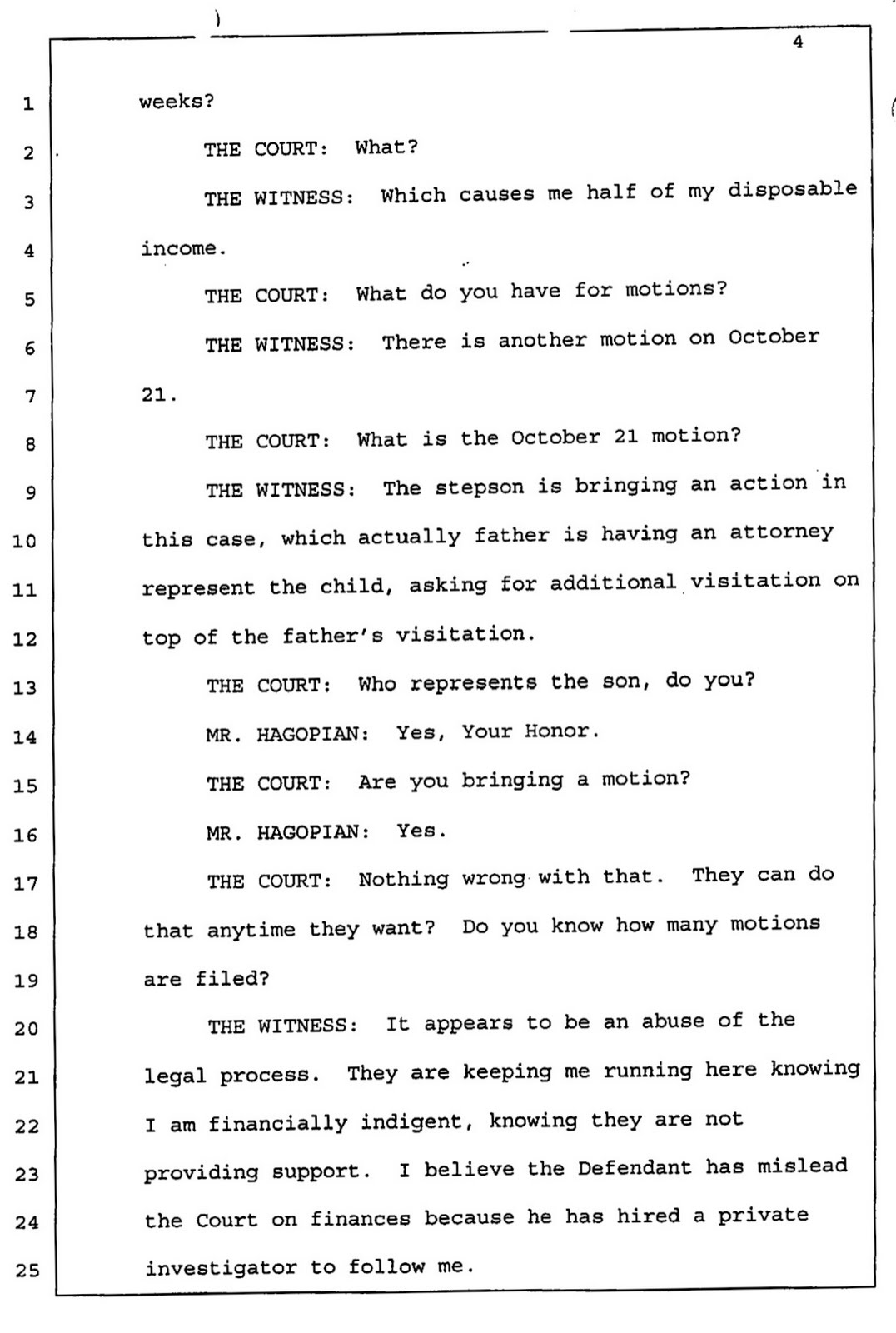
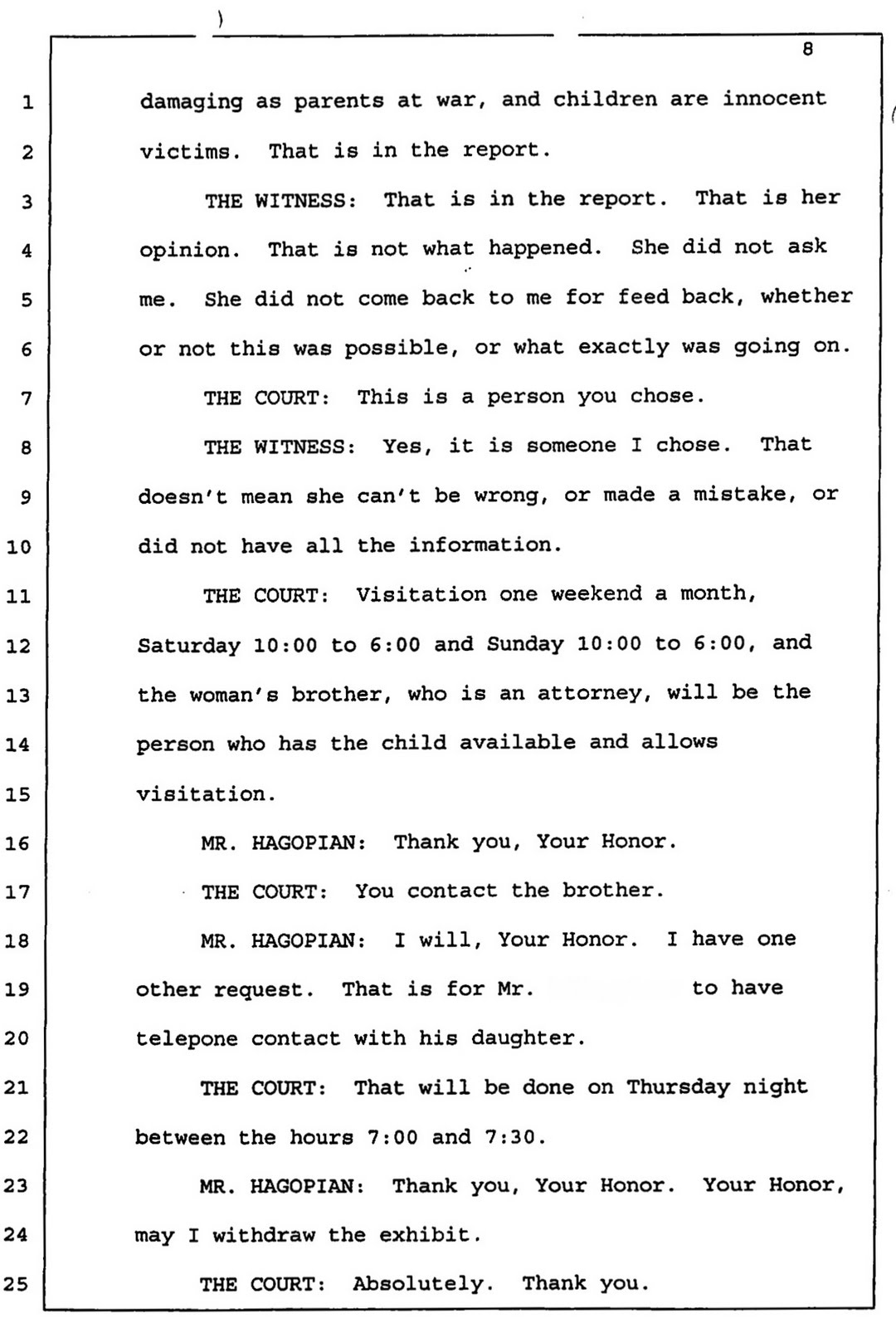
September 1994 Attorney Colangelo withdrew, and Michael Hagopian entered as Vincent’s lawyer. Chief Judge Jeremiah approved arrangements for Vincent’s supervised visits with his son in Illinois, plus telephone contact with his daughter on Thursdays from 7 to 7:30 p.m.

Vincent prepared a one-page “synopsis” of the transcript of that hearing that misrepresented Jeremiah’s order. (Click on documents to enlarge.)


In his synopsis of Chief Jeremiah's order (above), Vincent wrote:
After consideration, the Court concluded that it would be appropriate for [the mother’s] brother to deliver the child to [the father] for an unsupervised visit with his daughter (p. 6 lines 12-18). [I have italicized key words here and below.]


In fact those lines in the transcript refer specifically to the son alone, for Jeremiah instructed the mother:
… your brother will be there to have the child go with his father.


In his synopsis, Vincent misrepresented another point:
The Court went on to review the report of Childhood Trauma Treatment Program and concluded that there was not a credible story of molestation (p. 7 lines 1-11).


But in fact, Jeremiah’s reference in those lines applied only to the son, not the daughter:
. . . in reviewing the report of the Childhood Trauma Treatment Program, it stated my professional opinion these do not constitute spontaneous disclosures that list the father sexually abused him.


Here are excerpts of the transcript to compare to Vincent's synopsis. His synopsis referred to his former wife's complaints on page 2. In the transcript she is talking about his astonishingly low child support. (Click on documents to enlarge.)


On pages 6 through 8, the transcript refers to supervised visits with his son and phone calls with his daughter. (Vincent's synopsis of the transcript changed this to unsupervised visits with his daughter, with no mention of his son.)


When he drafted the final order, Hagopian did not go as far as Vincent’s synopsis had tried to revise Jeremiah's words. Hagopian drafted the order to give his client unsupervised visits and weekly phone calls with both children, but no overnights. And he got Judge Jeremiah's signature:


But a full decade later, Justice Michael Forte incorrectly described this order as if it had "reinstated unsupervised overnight visits."
After the results (unfounded) of the Illinois evaluation, the Chief Judge reinstated overnight visitation with both children by Order of July 29, 1994. (Forte, Decision, 7/6/2004:2)


[In fact Jeremiah clearly said "no overnights" on July 29. Forte is referring to the written Order of September 26, 1994, pictured above, which followed the Illinois evaluation, but also did not allow overnight visits. Later I will relate how mediator David Tassoni, with Justice Forte punished Vincent's children.

[Lawyers’ paperwork is a frequent cause of delay, expense, inaccuracy, and emotional distress in Family Court due to the failure to follow through on filing essential documents, the misrepresentation of judges’ orders, and the lack of clarity in many orders. Family Court does enormous harm when it uses adversarial litigation in these cases.

[A better option could be for evidence of crimes like domestic violence and sexual abuse to go to the Attorney General, Grand Jury, Superior Court, and jury trials. Helping families resolve ongoing crises would be far better served with a single multidisciplinary team from beginning to end, as described in the prior post. That team could include a writer and clerk responsible for timely filing of coherent and accurate documents. The Court needs to steadfastly remove opportunities for private contractors to profit from inflaming these cases.]

NEXT: 9.E. How "Vincent" got the Chief Judge to apologize.

Thursday, September 2, 2010

9.C. DCYF and the experts investigate, 1993

This case study begins at 9.A. below. (Click on August, then 9.A. in the Blog Archives at right.) My comments appear in italicized brackets.


March 1993 DCYF Social Caseworker II Lauree Gilmore, with Casework Supervisor II James Nerney, completed the home study. Their report showed:

• No criminal record or prior DCYF history for either parent. [They probably did not see the first wife's sworn affidavit detailing Vincent's alleged violence and threats to their child, the wife, and her colleagues at the college. I found her document in their divorce file in court archives.]

• Both parents denied abuse or neglect in their childhood. [My later research indicated that both had suffered childhood abuse. Court reports based primarily on self-disclosure are often unreliable.]

• Mother earned $300 weekly as a paralegal; Father bought and rented real estate, had a brokerage license and asserted that his attorney kept records of his income, which was “too complex to explain.” He said that he had “fourteen mortgages and three cars.”

• Both parents had been in individual and marital counseling. Psychiatric Specialists diagnosed the mother with “Battered Women’s Syndrome,” and she signed releases for DCYF to see her counseling records. Vincent denied having any diagnosis. He gave, but then revoked permission for DCYF to examine these records.

• The report recommended that the mother continue in counseling and the father “engage in services specifically directed to his marital violence” and that his visitation “should be dependent upon cooperation with treatment.”

October 1993 Physician Abraham Bartell testified that his exam of the 3-year-old girl showed “abnormal findings,” consistent with abuse, but not conclusive. He said “there needs to be an investigation by DCYF,” but he could not “state to a reasonable degree of medical certainty” that the child had been sexually abused. He concluded that “this child is safe in all of the settings” (Transcript 10/15/93:1-3).

Justice Shawcross reinstated Vincent’s unsupervised visits. The mother and children entered a shelter for victims of domestic violence, where a counselor reported to DCYF that the daughter showed signs of being sexually abused when she returned from a visit with her father. At first, the mother resisted believing this, but a child protective investigator (CPI) indicated the father for lack of supervision “as there was evidence that someone molested [his daughter] while in his care.”

November 1993 DCYF child protective investigator (CPI) Virginia Miller testified to the difficulty of proving anything without definitive evidence. She could not prove Vincent was guilty of a “lack of supervision,” but her testimony was troubling: “The children said that when they were put down for a nap [at their father’s], that they were given yucky medicine to take. . . . they slept for a long time.” When they woke up their father wasn’t there, and Miller realized it was the same day the father was in court. She concluded: “When I asked the father about it, he said it was none of my business.” (Transcript 11/18/93, p. 15-16)

[Four observations: 1. In other cases I have researched, children complain about allegedly abusive parents forcing them to take pills that make them sleepy. 2. This son later spoke of their father punishing him for speaking to authorities. 3. Experts often use the passive voice in courtroom testimony and reports. This is a common practice in the social sciences that results in vague descriptions that can waste costly hours in the courtroom splitting hairs that fail to establish reliable evidence or facts. CPI Miller never said who was identified by the children as giving them the medicine. 4. Domestic violence and sexual assault are crimes, which police are often better trained than social workers to investigate. A police officer should be part of the multi-disciplinary team I propose below.]


November 1993 The son, 4, told their tenant that their father held a “knife” to his sister’s back, gave her a bath, and gave her “bad touches.” Another CPI, Michael Bousquet, investigated and testified that when he asked the boy about this remark, the child said: “I’m not going to tell you, it’s a bad secret, you won’t like it. I won’t tell you the secret.” After saying this, the tenant told Bousquet that the boy was “shaking and trembling” (Transcript, 11/19/93:11-12).

Based on the children’s comments and his conversation with Dr. Bartell, Bousquet indicated the father for “sexual molestation, sexual intercourse and cuts, welts, bruises.” A later DCYF report stated that the father’s older son, 13, also was “indicated for sexually abusing” the girl.

Shawcross suspended Vincent’s visits and ordered Bousquet to coordinate his investigation with psychologist Brian Hayden.

December 1993 Dr. Hayden testified that Dr. Bartell had told him there was “a strong possibility” that the daughter “had been abused” based on one of her hymenal lesions. But Dr. Bartell acknowledged to Hayden: “I have not said that on the witness stand, but, between you and me, that is what I feel” (Transcript, 12/16/93: 43).

Justice Shawcross recognized the dilemma: three witnesses (the mother, CPI Bousquet, and Dr. Hayden) had testified that Dr. Bartell told them the physical evidence was “classic for sexual abuse,” but Bartell had not said that in court. Hayden was not convinced from his psychological exam that abuse occurred. He described the girl running from his office to urgently ask her mother to tell her father: “Don’t give me a boo-boo on my gina.” Hayden said the mother asked the girl to repeat her statement for Hayden. “The little girl would only say it as she laid on the floor. She was very agitated, very awkward, and did repeat what she previously said to her mother” (Transcript, 12/16/93: 53).

Hayden confirmed that the 3-year-old did in fact say this to her mother in his office, but Hayden “did not take that disclosure as a valid disclosure” because the repetition had to be prompted. He told Justice Shawcross that he found the case “troubling” because “There are a lot of pieces to the puzzle that don’t add up” (55). Although he recognized the danger that the girl could “get damaged because of this prolonged process”(48), Hayden wanted to see “how insistent and persistent this little girl was over a relatively long period of time” and he “spent over 13 and a half hours with this child.” He acknowledged it was “a lot of time” for such an evaluation, and he “never got the kind of specificity elaboration of details, placement of where something might have occurred” (56).

Hayden advised Shawcross that the girl should have “therapy sessions” with her father before any supervised visitation(58).

[Family Court still persists in sending traumatized children into “therapeutic” sessions with their alleged abusers. I will write more about insurance companies’ refusal to pay for such court-ordered “therapy,” how it compounds the trauma to victims, and how some psychologists may be billing insurance fraudulently for these sessions. Many judges place excessive confidence in experts who do not trust their own analysis.

[Dr. Hayden understood that numerous sessions might be harmful to this child, and yet he persisted. Normally, he charges parents an hourly fee, making every delay more profitable to him. In another case, I saw him delay his reports to the court for months until he received payment. At each hearing, he favored the parent who paid.

[Empathetic interviewers trained in child sexual abuse and able to set up a discrete video camera should promptly investigate each complaint in the home or some familiar, safe setting and help children to disclose these traumatic experiences. Bringing children to a strange adult in an unfamiliar office is hardly conducive to helping them talk about experiences they may have no language to describe.

[Rather than so many competing experts, a better model might be for each case to have a single multi-disciplinary team from beginning to end that would work together to investigate the facts and submit well-written reports and drafts of orders to the judge. Each team would include an expert in police investigation, mental health, medicine, law, and a skilled writer.

The team would not work as private contractors, but as salaried staff, professionally supervised in an accredited nonprofit agency. A team could better protect the child, hold each other accountable to high internal standards, and offer concise information and recommendations to the judge.]


NEXT: 9.D. How "Vincent" finagled the Chief’s order.