Color of Law Custody Cases

Color of Law Custody Cases
Rhode Island and other states often violate civil rights in civil courts when officials threaten to separate children from protective parents who are their lifeline. These cases may include "color of law" abuses that push the boundaries of law. Judges who allow color of law abuse in their courtrooms are guilty of "color of office."

In Family Court, we give judges ultimate power over people’s lives while taking away their curiosity, concern, and even their ability to inquire about what is really happening in these cases. This transfers the power to guardians ad litem and lawyers. These officers of the court can convince a judge--through false allegations that are frequently off the record--to remove children, imprison innocent parents, then bankrupt them through years of frivolous motions, and forbid them to talk about it--all under color of law.

In domestic abuse custody cases, this enables the abusive parent to gain extraordinary power and control over the protective parent and the children.

Here is more information about color of law:


Monday, March 19, 2012

10.N. A color-of-law case

There appears to be no record of some critical proceedings in this case -- such as the first day, April 23rd, 2008, when Judge Laureen D'Ambra switched "Jenny" from joint custody with both mothers to sole custody with Barbara. (The change was drastic, but that date never appears on the docket sheet.)

Jenny's two mothers, "Barbara" and "Tracy," had entirely different plans for the 23rd -- a Wednesday, when Barbara normally finished work early.

Tracy says she had made an appointment a few weeks earlier for both of them and their daughter to meet Attorney Christopher Corbett, who advertised mediation services in Options Magazine to the LGBT community. Tracy was to pick up Jenny from school and meet Barbara at Corbett's office for a free initial interview at 4 p.m. on Wednesday, April 23rd, to consider working with him on their family's issues.

Barbara had another plan: On April 22nd, she met with Attorneys Cynthia Gifford and Cherrie Perkins to work on a "Motion for Ex Parte Relief," a 12-point "Affidavit in Support of Emergency Order," a 24-point "Miscellaneous Complaint for Custody and Other Relief," and a partially completed list of her bank accounts, income and expenses.

On the 23rd, without notifying Tracy, Gifford and Perkins persuaded Judge D'Ambra to sign an emergency ex parte order awarding Barbara sole custody of Jenny. The documents they prepared are in the court file and entered on the docket sheet the following day. Apparently no record was kept of what they told the judge.
(Click once on documents to enlarge.)
That afternoon, as Tracy and Jenny arrived at Corbett's office, Gifford and Perkins were preparing a subpoena summoning Tracy to a hearing one month later on May 21st and informing her that "the Court has already issued Orders pending the hearing as set forth in the attached Ex Parte Order."

A transcript tells what happened the next day, on the 24th, when attorney Perkins appeared alone at a second ex parte hearing and asked Judge D'Ambra to give Barbara complete control over Tracy's contact with their daughter.

Here's how Perkins portrayed Tracy's actions the previous day:
Your Honor, after I was here yesterday, we informed our client [Barbara] of the court order and gave her a certified copy. We did advise her to contact the Defendant [Tracy]. . . and tell her that she'd retained counsel and give our name and tell her that there had been an order entered; and upon hearing that, the Defendant became a little upset and removed the child from school early, and this was not her day to have the child. . . . The Defendant took her to an attorney's office, which would be a violation of the order . . . . My office received a call . . . from attorney Chris Corbett, saying that he was sitting with the Defendant at the time, which would lead me to believe the minor child was there with him . . . . We left a message [for Corbett] this morning saying if you're going to enter your appearance, you should get down to Washington County Court . . . .
Still hoping to mediate, Corbett waited two weeks before entering his appearance as Tracy's lawyer on May 9th. He and Tracy worked that summer on a settlement, which Barbara and her attorneys rejected. The court hearings were all held without Corbett, and Tracy never met Judge D'Ambra.

Gifford and Perkins had composed the April 23rd order, but Judge D'Ambra inserted additional words: "pending a hearing on the motions" on May 21st. That hearing never occurred, though a key order was signed that day.

Shortly after noon on May 16th Gifford and Perkins faxed a "Consent Order" (perhaps to Corbett) purporting to reflect a hearing five days later on May 21st, "without the taking of testimony." Whether or not the scrawl identified as Corbett's signature was authentic, Judge D'Ambra signed the document that appointed attorney Kerry Rafanelli to be guardian ad litem for Jenny.


Though the judge apparently wrote "8/13" for the next hearing, Rafanelli was back in court on June 24th with his boilerplate order drawn up for the judge's signature, granting him all-encompassing authority without clarifying the cost or setting a limit on the tens of thousands of dollars he could charge Jenny's mothers while exerting complete control over their lives as guardian ad litem.
The Court defines this role in the broadest possible terms. The abuse of power by guardians ad litem , the damage they do to children and families, and their enormous bills are some of the most common complaints against Family Court.

Six days after Judge D'Ambra signed that order, Rafanelli wrote to Tracy and Barbara, once again without ever discussing the cost: "At this time I think it is in the best interests of the minor child to be involved in counseling" with psychologist Judith Lubiner.

Those first nine weeks reveal the patterns that played out repeatedly and still continue in this case and other color-of-law custody cases:
1. the use of ex parte emergency motions;
2. failure to notify the other side of court hearings;
3. creating fraudulent narratives, story-lines, and court histories;
4. accusing the other side of violating court orders that were not yet entered;
5. bullying and harassing the other side;
6. creating a professional cabal to financially exploit litigants and their children.
Three years later, Dr. Lubiner sat beside Attorney Rafanelli at a hearing of the Judicial Nominating Commission, forced to listen as Tracy and other parents testified against Rafanelli's bid to become a judge. Commissioners received 69 letters of support for him--17 more than the other eight candidates combined. His pile included a 4-page letter from Lubiner, two pages from Gifford and Perkins and two each from Judge Shawcross and Judge DiSegna. Those enthusiastic accolades may have hurt as much as the attacks did, for Commissioners dropped him on their first ballot.
(The Rhode Island Monthly lionized Attorney Kerry Rafanelli and two other guardians ad litem in their October 2003 issue.)

For more on cabals of court, see the February 22 and March 16, 2012, posts at
http://CustodyScam.blogspot.com
and
http://LittleHostages.blogspot.com/2009/12/why-did-lise-iwon-do-it.html

Wednesday, March 14, 2012

10.M. Zealous advocates

The "stress" at the Summer Institute for the Gifted (SIG), University of Texas, Austin

Yesterday's Providence Journal reports that six Rhode Island high schools--including three that serve some of the state's poorest students and three that are among the highest-performing high schools--have accepted state Education Commissioner Deborah A. Gist's challenge to have 15-year-olds tested by the Program for International Assessment (PISA) in these schools' effort to become world class educators (Jennifer D. Jordan, "Six R.I. schools to be part of global test," p. A1).

Among the six schools is the one that 15-year-old "Jenny" hoped to attend, the Jacqueline M. Walsh School for the Performing Arts (JMW) in Pawtucket (See "10.C. Jenny's dream school," below).

Five years ago, in March and April 2007, Deirdre V. Lovecky, PhD, at the Gifted Resource Center of New England, administered tests to then ten-year-old Jenny and advised her parents that Jenny "is a gifted girl who will need . . . an educational program that meets her needs for accelerated and stimulating work."

Lovecky's report is striking in its positive tone. She adds five detailed pages of specific opportunities and conveys a sense that parenting a child like Jenny is a great joy: "[Jenny's] parents might enjoy taking [Jenny] to museums, using a treasure hunt or scavenger hunt format."

One of Jenny's mothers, "Tracy," encouraged this approach, providing numerous opportunities for Jenny to do a wide range of activities, such as the Summer Institute for the Gifted (SIG) at Amherst in 2007, Vassar in 2008, and the University of Texas at Austin in 2009.

Jenny looked forward to going to SIG at Bryn Mawr in 2010, but Barbara cancelled her acceptance and sent her to different camps for two entire months in the summers of 2010 and 2011, rather than letting her spend any time with Tracy. This has become a common practice of Family Court psychologists who try to "deprogram" children who are emotionally attached to one parent.

Ironically Barbara claimed that Tracy sought to control Jenny and was making her life too stressful. Meanwhile Jenny grew increasingly desperate to communicate with Tracy.

When Jenny was 12, Barbara wrote:
On Friday, October 23, 2009, I went to wake my daughter and found her fully clothed, asleep, with a new cell phone by her side.
. . . I removed the cell phone, left a note and retrieved the messages she had received the night before . . . . When [Jenny] woke and discovered the cell phone missing and my note, I tried to talk with her. She went under her covers, went rigid and I had to literally lift her off the bed to get her to school. . . .
Barbara's attorneys gave the Court these alleged text messages, which began with the girl writing to her mother, Tracy, at 6:06 pm:
I have the apps
Tracy writes back instantly:
Soooooo happy 2 hear from you...do u mean apps for JMW? I was soooo worried about u all week not hearing from u... r u seeing Judith [Lubiner, court-ordered psychologist] 2nite or not?
Jenny responds promptly:
Yes. Im sorry 4 makin u wory. Gues what? Sensei said that he wuz bout 2 become a math teacher there but went to that other place first
Tracy uses this as a teaching moment:
really? ...see? he values the cultural arts. read the app carefully...I think u need a pic. I have some here or you take one with the photo booth on the MAC if you want so its current....yes?
It would be unfair to evaluate each mother's relationship to their daughter by contrasting Jenny's encounter with each of them in the scene Barbara portrayed.

But as I try to understand the manner in which Attorneys Cynthia Gifford and Cherrie Perkins zealously advocate for Barbara, and as I compare it to Tracy's zealous advocacy for Jenny, I am learning a lot about the games lawyers play (which I will describe in more detail later).

I could not continue to do this work if I did not believe that what happens routinely at Family Court in these disturbing custody cases will someday seem as absurd as other games that flourished once upon a time.
Paulus Hector Mair, de arts athletica, 1540s

Sunday, March 11, 2012

10.L. Every courtroom needs a ruler


On Friday afternoon two parents stand before the judge, with a lawyer between them saying one has stalked out of mediation. He angrily denies it and insists that his favorite psychologist can settle their case.

Next in line, Attorney Gifford questions her client, "Barbara," who also refuses to mediate.

What's a judge to do? At the end of a long week, the answer finally comes to me:

Let the deputy sheriff measure the nose of each litigant and lawyer every time a question is asked or answered. We will soon see which side is telling the truth.


(Pinocchio, drawn by Enrico Mazzanti for The Adventures of Pinocchio by Carlo Collodi, 1883.)

Friday, March 9, 2012

10.K. Searching for Best Practices

Yesterday was Dr. Ronitte Vilker's final day on the witness stand.

Once again, Attorney Cynthia Gifford tried to get the psychotherapist to discredit her patient, "Tracy," with a series of hypothetical questions and misleading assertions cherry-picked from an email Tracy had sent to their daughter "Jenny" twenty-nine months ago and from a 25-page letter Tracy had sent to "Barbara" nearly four years ago.

Attorney Keven McKenna objected repeatedly, but Judge Debra DiSegna overruled him.

Dr. Vilker insisted that Gifford's questions ignored the context for Tracy's remarks and the way in which a person with autism spectrum disorder (ASD) might normally respond to the pressure she was feeling.

Gifford tried to get Vilker to imply that Tracy could suffer from other psychiatric conditions than ASD and PTSD. Judge DiSegna pushed the HIPAA envelope by asking whether Vilker would refer her patient for further tests. Dr. Vilker's discomfort was visible.

She looked at Tracy, who nodded.

Dr. Vilker said she wanted to continue working with Tracy, who had voluntarily sought her help. She would recommend that Tracy also work with a doctor who specializes in helping patients with ASD to develop skills for examining their thoughts before expressing them in ways that may prove counterproductive.

DiSegna inquired: Could the Court order specify that Tracy must cooperate with her therapist?

Vilker responded emphatically: No! That would undermine the therapy.

Vilker said she would never return to the courtroom, and DiSegna assured her she was not subject to the Court in any way.

This important exchange underscores what I've seen over two decades of Family Court custody cases: a few psychologists are doing enormous harm to children and families by delivering Court-ordered "evaluations" as a business--similar to the testimony Attorney Gifford kept trying to extract from Dr. Vilker.

Attorney McKenna asserted that the Court is not qualified or authorized to be in the business of behavior-modification. He asked whether it is harmful for a child to be separated from a parent for two and a half years when there has been no evidence of abuse by that parent. The therapist agreed.

I have been listening to delightfully engaging interviews of David Finch, author of the new book, The Journal of Best Practices: A Memoir of Marriage, Asperger Syndrome, and One Man's Quest to Be a Better Husband.


http://davidfinchwriter.com/radio

David and his spouse, Kristen, describe the undeniable challenges in their relationship and how they are overcoming them together.

This raises yet another hypothetical question:

How much better off would Jenny and her parents be today if Barbara had known in advance what Dr. Vilker has learned? If only she had stayed far, far away from Gifford, Perkins, and the adversarial mindset of Family Court.

Thursday, March 1, 2012

10.J. Déjà vu all over again

Some readers thought Attorney Cynthia Gifford's subpoena of me meant I was headed to prison. Not so. As ordered, I appeared in court yesterday, where no mention was made of my subpoena. These are tricks some lawyers play to intimidate, complicate, and if possible, accumulate billable hours.

"Barbara's" attorney, Cynthia Gifford, continued her cross-examination of Dr. Ronitte Vilker. "Tracy's" attorney, Keven McKenna, continued to object, saying Gifford was raising subjects far beyond the scope of his original questions and Barbara should pay the psychologist's fees to use her as an expert. Judge Debra DiSegna denied his objections.

But the judge also pleaded with Gifford to conclude her tedious cross-examination--which involved lengthy hypotheticals calculated to get the psychologist to say her patient, Tracy, was untrustworthy, a failure as a parent, a danger to her daughter, and incapable of co-parenting with her former partner.

It was déjà vu all over again, recalling the history of another psychologist, the late Dr. Judith Lubiner, on this case nearly three years ago, which I will recount at another time.

Snow and sleet fell outside, and another expensive afternoon slipped away at the Washington County Courthouse.

Then something remarkable happened. Gifford protested, but Judge DiSegna needed to ask the doctor some questions. In that instant, the atmosphere changed from an adversarial game of Gotcha to a heartfelt conversation between the expert and the judge about how they could make the future better for Jenny.

A wasted afternoon became some of the most potentially productive minutes in this case. The clerk and stenographer agreed to stay longer as we watched a scene unfold that needs to happen more often if Family Court is to provide the wisdom and justice that good parents hope for when they come here.

Monday, February 27, 2012

10.I. EMERGENCY!

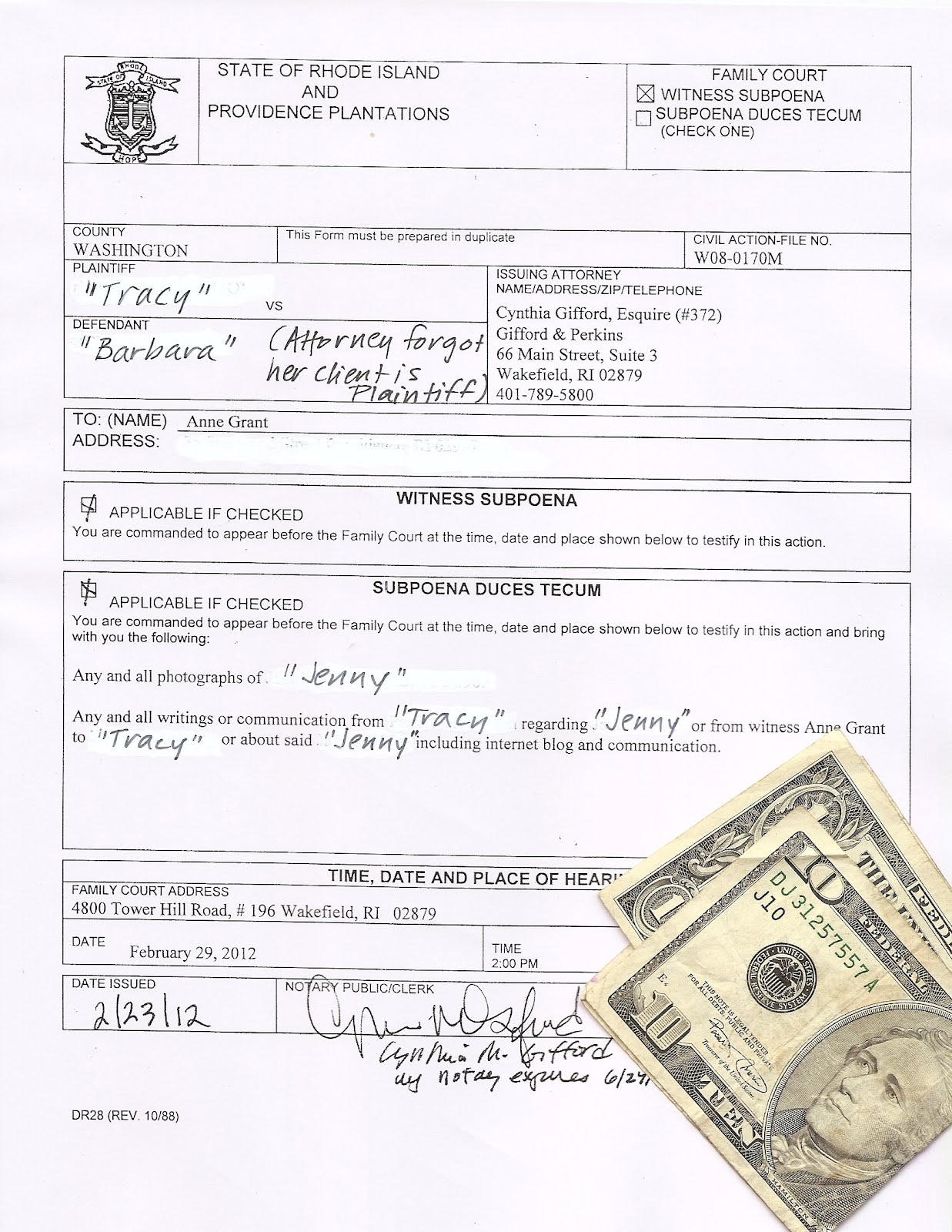
While I sat outside Courtroom 1 in Washington County Courthouse last Thursday (forbidden to enter because Attorney Cynthia Gifford suddenly presented me with a subpoena), little did I know that I had become the latest "emergency" in this case. I found out today that Gifford filed an "EMERGENCY MOTION TO ADJUDGE [Tracy] IN CONTEMPT."

Gifford even imagines that these blog posts are
intended as a contact with the child [Jenny], who is able to access them from the Internet and that said Anne Grant is acting in concert with the Defendant to be in contempt of the orders of the court.
Poor Jenny! What kind of haranguing must she contend with now? The Digital Age has not been kind to her with all the apparent punishments for trying to send text messages to her mom.

So Judge DiSegna must rule on what appears to be the seventh in a series of bogus emergencies and ex parte motions (which are a favorite tactic of batterers in Family Court; Sneaky people tend to get paranoid.)

This emergency motion even suggests that I am a "friend of the Defendant." That's ironic, for I never knew "Tracy," until I heard about the legal abuse she and her daughter have been suffering.

Gifford and Perkins' shenanigans have brought this amazing mother and daughter into my life.

I would be honored if someday Tracy and Jenny became my friends.

Friday, February 24, 2012

10.H. My $11 ticket to the courtroom

(Click once to enlarge.)


As expected yesterday I finally got my subpoena, accompanied by the usual $11.00 witness fee. (Someone in our Family Court industry--that scarfs up 20.8 million taxpayer dollars in Rhode Island's 2012 budget--has a sweet sense of humor.)

The subpoena forced me to sit outside the room yesterday, so that Gifford and Perkins did not have to read my courtroom observations on this blog today. It gave us both some breathing room, more time for me to research the cabal that has been feeding off this child.

On February 29th, they will devour my documents in a fishing expedition to vilify Tracy, Jenny's lifeline Mom. Gifford will ask me questions, slowly and painstakingly, to stretch out her billable hours.

I want to cut the cost to Barbara's family by providing a few answers here:

Q: What is your name?

A: Anne (with an e) Grant

Q: What do you do?

A: I'm a retired minister and a writer.

Q: Is "Tracy" a friend of yours?

A: She is friendly. But we focus only on the Court. We do not socialize.

Q: When did you meet Tracy?

A: In 2009. Someone referred her to me after reading my book review in the Providence Journal that described narcissism in Family Court hearings. Tracy came to talk with me at the Mathewson Street Church.

Q: What did you talk about?

A: About their family history and what was happening in this case.

Q: Did you offer to help her?

A: I told her how I research cases.

Q: And what did you tell her?

A: First, I'm not a lawyer and I cannot offer any legal advice.

Q: And what else?

A: Second, I accept no money.

Q: Who pays you?

A: No one.

Q: What else did you tell her?

A: Third, I do not represent any litigant, but I try to see what the child's needs and concerns are. If Tracy wants me to do that, she must give me all the documents she can, including photographs, drawings, letters, anything that will help me understand how the Court is handling this case. Then I will access the public file at court.

Q: Anything else?

A: I will attend hearings, but not on either party's side. I will focus on the court process and how it seems to help or hurt the child. If I consider the process harmful or legally abusive, I may challenge it in my writing.

My purpose is to stop Family Court from harming children and families, to make it accountable for its actions, to end abuses by officers of the Court.

Q: What else did you tell her?

A: That I will keep what she tells me in confidence. I will not write about the case unless I believe it is in her child's best interest to expose what is happening. I will use false names. She may not agree with some of my conclusions. I will always welcome corrections from her or anyone else.

Q: Did you ever meet Jenny?

A: Yes. Whenever possible, I want to meet the children I write about.

Q: When?

A: 2009.

Q: Where? At the Temple to Music in Roger Williams Park. At Goddard Park.

A: What did you talk about?

Q: Mostly we played--some games with a ball, something like hacky sack in a sock. Jenny taught me to find crabs at the beach.

A: Did you talk with her about court?

Q: Very briefly. I told her that I research custody cases to find ways that might improve the Court's work with children. I said her ideas are important.

A: Was Tracy part of that conversation?

Q: No. I asked her to watch from a distance, said I needed to hear from Jenny in private.

A: What else did you ask Jenny?

Q: I encouraged her to talk to the court-ordered psychologist, Dr. Judith Lubiner. She said it didn't help. No one listened to her.

At this point Attorney Gifford will ask the judge to strike my answer: Hearsay! and change the subject.

Q: Why did you post old photos of Jenny online?

A: Because it helps readers understand the importance of this relationship.

Q: What about the photo from 2009? People will recognize them.

A: Anyone who recognizes them already knows that horrible rumors have been spread like slander in our community about Tracy. Somebody needs to let people know there is more to this story than what they have been told.

Q: And you think that's your job?

A: I think it's everyone's job. This Court operates with our money and in our name. If we do not speak up, then we share the shame.

Q: What about the other children in the picture? Did their parents give you permission to use that picture?

A: Yes, their mother took the picture. She said Tracy would let me use it, too.

Q: Did you take pictures of Jenny at her concerts?

A: Yes.

Q: And you gave them to Tracy?

A: Yes.

Q: Why?

A: Because it's wrong for you to keep Tracy away from Jenny's concerts, her graduation, her track meets. At her concerts, I've seen how Jenny stands alone and searches the audience. She's looking for Tracy.

Q: When did you take this picture?

A: May 21st, 2011.

Q: Did Jenny know you were taking her picture for Tracy?

A: Yes, I told her, and her whole face lit up. She's a beautiful young woman. She deserves to live at peace with each of her mothers.